finding my childhood in kingdom hearts

The other day, I saw an advertisement for the release of Kingdom Hearts III on a red, double-decker bus passing through Gower Street.

Later, I came home to write my essay on the religious allegories in Defoe’s Robinson Crusoe due the upcoming Wednesday. But, I could not get the release of Kingdom Hearts III out of my mind. I remember, after I had finished Kingdom Hearts II for the first time in the winter of 2006, I had checked a couple of times during the subsequent months in hopes of finding news about the release of Kingdom Hearts III. Because Kingdom Hearts II had been released three years after Kingdom Hearts, I expected them third installment to come within a couple of years at best. But, now it’s 2019, which is 14 years after Kingdom Hearts II, and Kingdom Hearts III has finally come out.

Despite owning a PlayStation 2, which I remember to be a gift, my parents did not let me play video games growing up. During 5th grade, which was the first year I was not involved in an after school program, I remember coming home at around 3 PM and play Kingdom Hearts II until around 5:30 PM, which was around the time my mom returned from work; I remember calculating through adding a 30 minute commute to a 5 PM end time. When I would hear the wheels of her Honda Accord pulling up to the drive way, I would rush up two flights of my stairs back to my room. Since the basement had been barren at the time, the only reason I could possibly be in the basement was to play video games.

I did not own many video games. On PlayStation, I only owned Kingdom Hearts and Kingdom Hearts II along with a racing game called Need for Speed Carbon that got bland within minutes of playing. Especially with the absence of guides and my primitive reasoning faculties, I remember playing Kingdom Hearts endlessly because I did not have a conception on how to finish the game. The first Kingdom Hearts had been especially difficult, so I would frequently re-play Kingdom Hearts II on a couple of occasions. I remember finishing the game twice, once in 5th grade, and then again in 8th grade. Then high school and college happened, and I forgot that Kingdom Hearts existed at all.

But seeing the advertisement for Kingdom Hearts III on the bus passing by me, I could not help but to replay some of the scenes from the previous few games on YouTube when I got back to my flat. I started with watching the ending to Kingdom Hearts III, which I did not appreciate as much as I could have probably because I did not play any of the several other Kingdom Hearts games that came out between Kingdom Hearts II and III, but I found the ending to be a bit underwhelming, perhaps because I have higher expectations now than I did in the past about the qualities of a good plot that did not necessarily fall within as wholesome of a game as Kingdom Hearts.

But, in reflection, the series of Kingdom Hearts was more melancholic for me to understand at the time. The entire premise of the first and second Kingdom Hearts game is about a comfortable world that is shattered by environmental disruption. The first Kingdom Hearts starts on a place called Destiny Island where a trio of three children blissfully live in untainted happiness until the island is attacked by the Heartless, which results in Sora and Kairi never getting to share a paopu fruit (which is actually so sad). The second Kingdom Hearts starts in a place called Twilight Town where a kid named Roxas is raising money to go on a summer vacation with his friends before his body and identity is acquired by Sora. Real happy stuff.

It seems that even all those moments of happiness are adulterated by a bittersweetness that mirrors the progression of life. In the ending of the first Kingdom Hearts, Sora splinters his heart and body in order to release Kairi’s heart and save her, which results in the creation of Roxas, whose life is ruined by the player within the first hour of the subsequent game. The moment Sora and Kairi have the opportunity to be together once again is the moment they are separated again. The reunions are corny as usual, but behind every moment is an understanding that all events are caused through an undeserved expulsion from Eden. And, similar to the their exit from Destiny Island, I too miss the time when I had lived in Eden.

It is not that my youth had been blissful. In fact, I consider my childhood and adolescence to be some of the most difficult years of my life, but I also believe my difficulties back then had lacked the complexity of the problems that I have now. I could conceptualize love in respect to having a crush on any Asian girl in my class without the emotional baggage of a couple of instances of shattered love that I have now. I could conceptualize success through getting straight As in school without even reflecting on the nature and reason for success. I could not even conceptualize meaning because I had no concept of meaning back then. All of my problems had solutions, and I miss those moments of ignorance.

The dialogue in Kingdom Hearts is meme-like in how bad it is. But, when I had played this game as a child, I did not take notice of the dialogue. Now, watching the same scenes again as an college student, the exaggerated inflections and stiff body motions evoke a yearning for the time that I could watching the same corny phrases of hearts and souls without a cynical lens. From my current point in my life and onward, I probably could never play Kingdom Hearts and have the same patience with the dialogue as I once could as a child. I do not find the same jokes funny anymore, but I occasionally let out a bittersweet laugh at the warmness shared between Sora, Donald, and Goofy.

But perhaps the most sentimental part of Kingdom Hearts is the music. “Dearly Beloved” by Yoko Shimamura, the title track of the game, is a song that I listened to every afternoon in some years of my life when I booted up Kingdom Hearts in my clammy basement and sat on my blue-gray carpet with my back against my leather black couch. “Treasured Memories” evokes those occurrences that will never happen again in our lives, regardless of how joyful or hurtful the memory has become. “Roxas’ Theme Song” recalls the the yearning for a summer vacation that never happened, the melancholy that follows the acceptance of an unrealized goal, the beauty of ephemeral relationships in our lives.

I almost cried when I clicked on a video of the short film in the introduction to Kingdom Hearts II. Even by myself in my room, I had an emotional response. The shimmering sound of Sanctuary by Utada Hikaru is met with the electrifying wave of my spine. The cutscene mirrors the sentiment of the game but also life: a chase discovered in our childhood that propels us to fight for reclamation only to have our obsession slip away when we have reached the point of possession. I recall all those instances of cringe and loneliness that that permeate my experiences in my compulsory education, but for some reason, I miss the same years of my life that have caused me so much of the suffering I continue to experience now.

It almost seems that Kingdom Hearts is a game created with the design of being sentimental. I have clearly fallen into their sentimental trap. And, seeing as it is relatively impossible for me to enjoy the third installment of the series as I did the previous two, I can only reminisce on how Kingdom Hearts has shaped me to become the person I am now. Oh, how I miss those afternoons alone in the darkness of my basement. My lonely past unadulterated by all those moments of disillusionment that have followed, when I could truly hold the simplicity of life into my hands.

Because, like the fate of Destiny Island, the Heartless came, and I will never return to Eden ever again, no matter how lonely Eden was in the first place.

vegetable pasty at euston station

On Sunday afternoon, after Church services but before playing Dungeons and Dragons with the UCL Knitting Society, I went to Euston station in search of a Sainsbury’s to sate my appetite. I wanted to purchase a sandwich with perhaps a vegetable to be eaten raw on the side, but I found no such luck. Instead, I wandered upon The Pasty Shop, which I could only assume sold pasties. But, perhaps aptly, the shop also sold coffee in addition to pasties.

I had previously had a pasty at the UCL Student Center while doing a problem set for my only economics course for the semester, Issues in Development. Spending the majority of the day in front of a screen attempting to use basic R commands into Stata tends to do that to me. I had purchased a chicken and leek pasty then, which had thoroughly filled me with a desire to pass out upon finishing. As someone who values green vegetables in my life, I found my first attempt of eating a pasty to be as expected. After all, I was eating a buttered crust with a buttered interior with some extraneous pieces of meat and vegetables.

My second attempt had largely been reminiscent of my first attempt. I had purchased a vegetable pasty from The Pasty Shop because it had been £1 cheaper than the meat-filled alternatives. The taste was very similar regardless of sprinkle of corn found inside. The crust flaked in my hands, but the juices inside soaked into the crust and onto the paper bag where I held it. I had previous finished a Mars bar, which had been given to me upon entry to Church, and I had not been too hungry. Bloomsbury Fitness had been nearby, and I decided to go to the gym because of its proximity. But, because I had made the trek to Euston station, and made the sunk cost of about hundred steps, I decided to eat a pasty anyways.

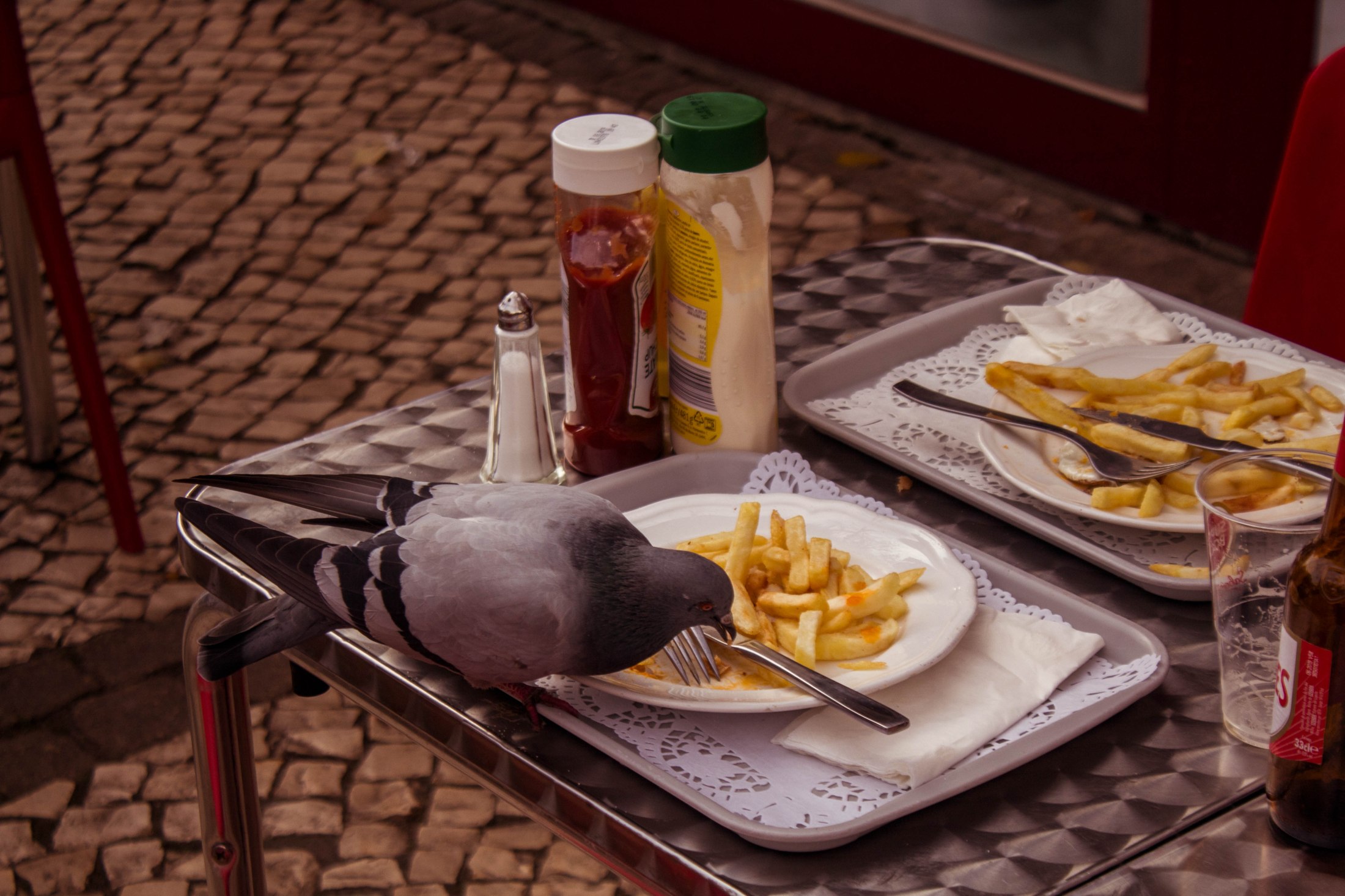
A pigeon dawdled in front of my feet as I ate my pasty. The atrium of Euston station had been quite open and significantly warmer than the outside. I would wonder why any pigeon would prefer to spend time outside when there exists such an ideal depository of leftover found dispersed throughout the ground here. The area around the trash can was littered with half-filled bags of potato chips. I would imagine part of the reason is sex. There does not seem to exist enough pigeons indoors to create a cohesive social community for mating. But, as I have no background knowledge of pigeon ecology, I could be completely wrong. In reflection, I am probably completely wrong.

A couple of loud boys collectively sung a song outside. Some other boys, who I assumed were not affiliate with the group of boys who started singing, joined in. I assumed it was some sort of sports team chant, but I could be completely mistaken. A cover of “Falling in Love With You” played from the sound system of the station and over the sound of their chants outside. But, underneath all the music, the sounds of living continued. The cash registers opened with the signature clink of coins hitting from the inertia. The paper bags rustled with the motion of people grasping for the food within. The snickering of an old couple walking past me.

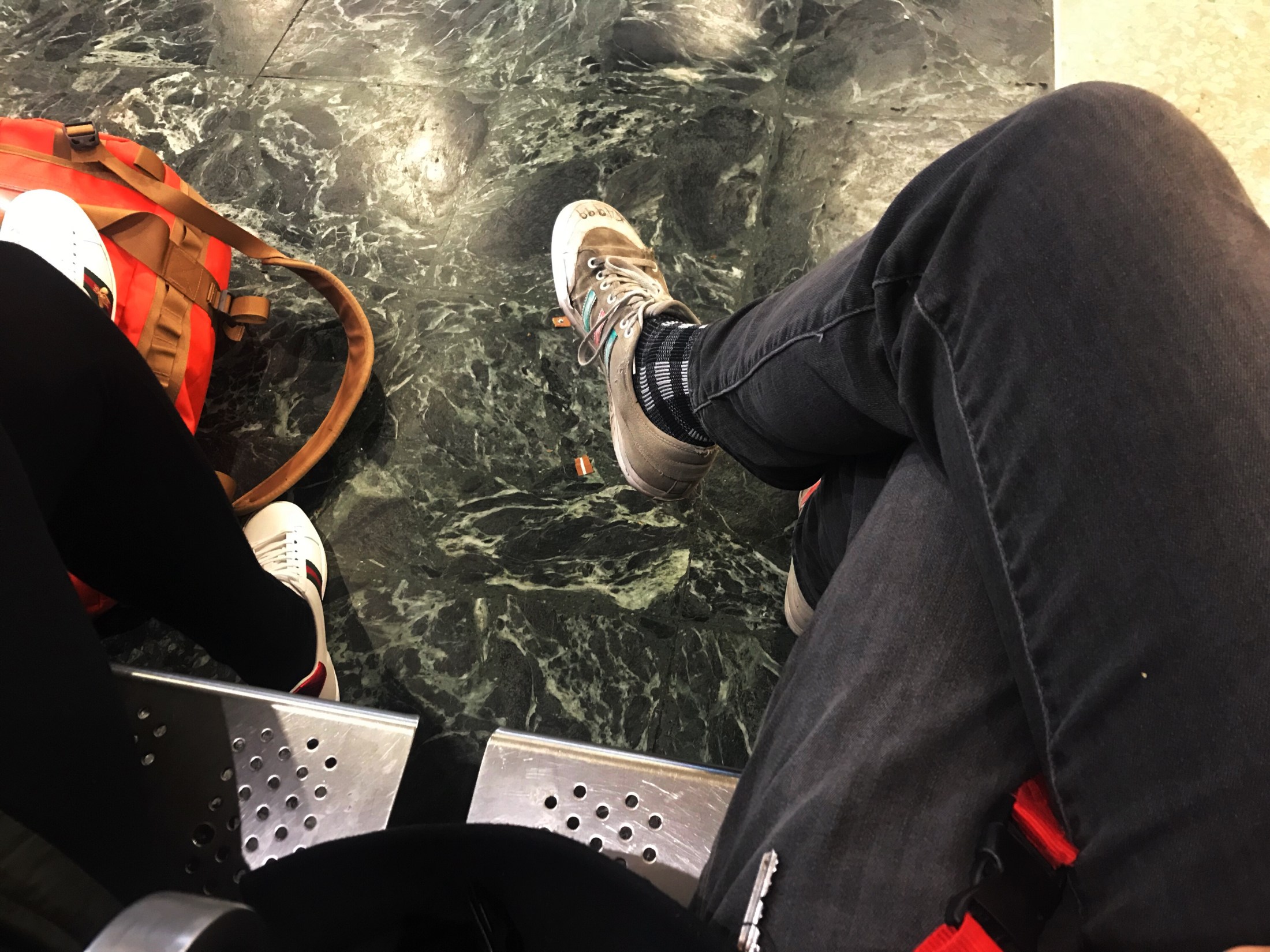
In the midst of writing this, the occupants of the seats around me have been replaced at least three times. I am merely sitting down to eat and write. My pasty had long been gone, leaving me only with the metal against my butt. The other individuals in the station have trains to catch, but I do not. I will leave the station in the same direction I had come, which is through the main entrance. I cannot say the same about the others who entered the station. It is 1:51 PM, and I am waiting, but not for a train. Alas, I think it is my time to part.

I found the Sainsbury I had been looking for upon exit.

the night tube

I left the Ministry of Sound at around 3 AM completely sober. I walked past the a collection of drunk people loitering at the entrance. As per usual, they were doing drunk people things. Usually, the presence of garishness bothered me because I found loud conversation to be an uncalled assertion of existence. But, at the moment, I found any noise other than the cutting bass indoors to be quite refreshing, which included the turbulence outside.

I had lost my hearing protection at another concert about a week prior. It was the second pair of high fidelity earplugs that I had lost over the past year, a feat that made me question the strength of my responsibility. My ears were accompanied the buzzing sound of tinnitus because the D.I.Y. earplugs I had created from the toilet paper in the bathroom had been inadequate, although it had been a significant improvement from nothing. How the majority of these people could spend prolonged periods of time in a space that caused my skull to rattle with ever bass note was beyond me.

I expected to take the Bakerlooo line back to Regent’s Park station, as that was the way I had originally come, but only until I reached Elephant and Castle station did I realize the error in my assumption. I expected that the tube would be open on Saturday evening. But, even though I had seen warnings for its closure in the past, I did not take into account that the Bakerloo line is under construction during the hours of night tube operations for the next couple of months. Such was the sad sight of me peering into the metal gates of Elephant and Castle station.

I walked aimlessly for a while, unsure of how I could resolve my predicament. After all, I did not have internet if I did not have a WIFI connection, and at that moment, I could not expect salvation from WIFI. I did, however, have the map of London rendered onto my Google Maps app. Despite my inability to recognize a simple path home, I roamed the streets of South London (with the heavy assistance of Location Services), and eventually made myself to Waterloo station, which had not been closed.

A couple of weeks prior, I had met a poet at a Sofar Sounds concerts who recommended that I take the Northern line at night if I ever needed inspiration to write. Seeing as I do not arrive home past midnight, I saw my current predicament as a great opportunity to do so.

The car I boarded had around a dozen people. A man sat next to me and asked me where I was from, which I replied, “The States,” which he replied, “Where in the States?” which I replied “Philadelphia.” The question did not bother me as it once did, as I have come to realize that the majority of my supposed “correct” opinions on race and gender are merely a means for me to assert my education at a prestigious university surrounded by other privileged students who affirm subjective opinions to universal truths. After all, a baseline understanding of race and gender does not allow me to condescend others for not having the opportunity to explore the same topics that I have had a privilege to learn.

He then asked if I watched Pokemon, which I replied, “When I was a kid,” to which he replied, “Then what Pokemon is this,” pulling out a yellow rat-like figurine from his pocket. He says, “It looks like Pikachu right?” I did not think the plastic toy had the appearance of Pikachu, but I could not articulate the Pokemon it resembled. Then, his friend chimed in, “I don’t know what it’s called, but it’s that sand Pokemon with the claws.” I reflected and agreed. It did look like “that sand Pokemon with the claws.” Then, the name bubbled into my consciousness along with all the other childhood memories I have with Pokemon. “It’s Sandshrew!”

A couple of minutes later, a woman sat in front of me and started to read a book. It was a thick book. Upon seeing the picture of Marcel Proust on the back, I immediately identified it as In Search of Lost Time, at least one of the seven volumes. I was tempted to introduce myself, as Proust is a writer that echoes many of my opinions regarding love, but seeing as it was approaching 4 AM. in the middle of a presumed ride home, I decided not to. Of course, I would probably do the same thing during the day; inducing a conversation with a stranger in the tube is just weird.

The woman seemed to be fully sober (as she was reading), and I wondered where she could have possibly come from. Reading in the tube is a matter of habit, as it requires an instinctual understanding of where to get on and get off. From my experiences of getting accustomed to the London underground, it is very difficult to focus my attention when I was preoccupied with not missing the stop indicated on my phone. And, for her, I wonder what about getting home approaching 4 AM is a matter of habit. Perhaps she worked at a bar or a club? Her outfit was quite modest, which would strike that idea. Alas, I wonder!

As I approached the end of my journey, a drunk man stumbled in and landed on a seat. He was clearly intoxicated beyond comprehension. The drunk man eyed two men next to him began bantering with them, who seemed tipsy but no drunk. I could not hear their conversation, but from the gestures, all three men seemed to enjoy each other’s company. Or, at least, as close as individuals are under the influence. At one point, the drunk man pulled a pre-rolled cigarette out of his pocket and lit it in the middle of the subway car. The two other men exclaimed loudly and gestured wildly, to the uncaring ears of the drunk man.

After a few laughs exchanged, they returned to a state of silence. The drunk man finished a quarter of his cigarette, left the car, and sat down on the benches lining the wall. The smell of the smoke remained in the car for another couple of minutes, although the people who entered the car when he left did not seem to notice. The two men who shared the conversation with the drunk man left one stop after he did. One stop later, I got off at Warren Street station, which had been conveniently located next to a 24 hr. McDonald’s that sold £1 chicken mayonnaise sandwiches. Thus, I concluded my journey on the night tube.

I came back to my apartment long after the house had gone asleep and observed the silence for a bit. The birds were not chirping; it was not one of those nights. Then, I set an alarm for 10:30 AM and went to sleep.

one conversation is all it takes

On the train back from the fields of Flitwick, I reflect upon the lyrics of “One Kiss” by Calvin Harris (ft. Dua Lipa).

One kiss is all it takes
Fallin’ in love with me
Possibilities
I look like all you need

Except, of course, in substitution of a kiss, a conversation.

I wonder how many minutes of conversation it would take for an individual to truly understand another individual, whether it is at all possible for us truly to understand one another through the a medium as imperfect as language. Even as I am sitting on the tube, watching those individuals with an attractive aesthetic come in and out of the car, I can only venture to speculate about their philosophies and lifestyles because I will never have the chance to have a conversation that would otherwise change my perception.

During my walks over various scenic territories with the Hiking Club at UCL, I would have the opportunity to have countless “nice chats,” as one member put it, with countless individuals that I have never seen before. Given the nature of hiking, we would have countless hours to experience without the reception that would allow us to indulge in distractions, not that I consider social media merely to be a distraction. As a result, I tend to exist in one of two states of existence: appreciating beauty or having conversation. I would, generally, alternate between the two, cycling through the exhaustion onset by conversation through the guttural sound of mud squeezed under my feet.

These conversations would start from nowhere and end in nowhere. Conversations would begin with, “What do you study?” (I have learned through experience that “How have you been?” will be sometimes answered with “I’ve been waiting for a couple of minutes”). From there, I would progressively ask questions that would prompt longer and more personal responses, careful to pace my line of questioning with my observations of their replies to ensure that my presence is neither that of an interviewer or a creep. Sooner or later, we would reach an equilibrium where information would flow without the awkward frictions that exist in the beginning.

After a couple of minutes or hours, the conversation would reach its natural conclusion. Forcing the continuance of such a conversation would do an injustice to the pleasantness of the conversation that had happened previously. And that would be it. The conversation may have ended, but the hike has not; we would still need to spend the next couple of hours together regardless of if we have the will to hold a conversation. So, in response to our assessment of our current desire to have conversation, we would choose either to walk in silence or find another individual to create another conversation from nothing.

But, if done will, one conversation is all it takes to understand another individual. Not fully, of course — it would be impossible for anyone to fully understand another individual — but enough. An outline of someone’s existence can be drawn from one conversation, especially those conversations that lead to feelings of captivation. Fundamental pillars of personality and character — aspirations, regrets, relationships, preferences, etc. — can be made tangible after one conversation, bust most importantly, compatibility can be assessed after one conversation. At least, an indicator of compatibility.

Until a conversation is had between two individuals, there could never be understanding that is shared. All that exists before conversation are images, and images, though existing on a degree of reality, could never replace conversations in its magnitude of reality. If the conception of an individual could be quantified into its their magnitude of impression, then it would be unreasonable to equate individuals who have had conversations with us and those who have not. Images, in our mind, only have the existence of images, which do not have as much thought put into them as impressions, which we have deemed to have more thought and thus more reality.

Even if conversations are forgotten, the mere act of speaking creates something out of nothing. Even if the ideas that are exchanged and melded do not continue in the thoughts of the subject of the conversation, the mere act of speak links two individuals through an idea that exists within the collective unconscious regardless of if the idea exists on a greater degree of tangibility as an idea that comes into existence as through the metaphysical cause of a thought. And, the more unique the conversation that is shared between two individuals, the more that it exists on a degree beyond the its cause of creation.

In such instances, I default to Kierkegaard’s conception of existence.

To exist is to be different.

György Lukács,  Soul and Form

It is through these conversations I realize I am profoundly alone. While the nature of conversation necessitates an expiration date, I wonder how close I could truly be with someone through sharing conversation at this point in my life. I wonder because it would be naive for me to say that I could create friendships with the same ease that I could have in second grade, when I had moved schools for the first time. I no longer have the same upbeat personality that would have been deemed compatible with most of my peers at the time. To say that I have matured into an individual more compatible than my previous self would be a laughable mistake. My life happened, regardless of how much I could control it, and here I am.

If conversations end eventually, it also means that contact between two individuals contingent on the continuance of conversation would also come to an end. Even as I am gaining insight through the conversations I have, I can never fully appreciate the value of conversation for its ability to cause happiness when I have already come to terms with the end of a conversation. As a result, I treat the ephemerality within my interactions with others, especially those individuals I have just met, with bittersweet salutation. Each greeting serves both as hello and goodbye, and I can only observe its happenings as a bystander to myself.

Once conversations end, the only possible recourse to maintain contact would be to reignite another conversation. The possibility of rekindling, however, is contingent on a series of environmental factors dependent on both parties having a threshold desire to continue a conversation. Given the frictions that exist within its creation, it would seem that only after a certain level of compatibility is met can there be the necessary set of conditions to continue a conversation beyond the environment in which it originally incepted. In the age of modern living, I wonder if such possibilities could still exist for someone like me.

I wonder if I have reached a point in my life where each beginning has already spontaneously spawned its equivalent end. The environment in which I live will not become friendlier towards the creation and maintenance of friendship. While conversation, although waning, will realistically never truly die, the ability to continue to existence in the presence of friendship has the potential to fade into nothingness. If I defined the meaning of my life through my relationships, I wonder — is it time to redefine how I derive meaning from my life or is it time to conclude my life?

If I could, within my egoistic conception of the world, cause existence through the mere act of having one conversation with another individual, I wonder if the creation of a tenuous relationship defined the full extent of my metaphysical goodness. Should I have faith that a being with more metaphysical good than me will create a relationship beyond the metaphysical power that I have, or am I merely experiencing the limitations of my existence? Have I reached the proverbial end of the sidewalk, and if so, I wonder what it is recommended that I do once I have reached the end?

Let us leave this place where the smoke blows black
And the dark street winds and bends.
Past the pits where the asphalt flowers grow
We shall walk with a walk that is measured and slow,
And watch where the chalk-white arrows go
To the place where the sidewalk ends.

— Shel Silverstein, “Where the Sidewalk Ends”

When I had been a child, such a poem had seemed an easygoing interlude that defined my time after recess before classes started again for the day. I read the stanza from the same poem wondering if the end of the sidewalk referred to the act of dying. It would make logical sense, as when an individual falls off the end of the sidewalk, they would fall into nothingness, and thus die. To truly escape from the smoke that blows black, we cannot merely walk on until we have eluded the smoke; such an idea would operate on so many incorrect conceptions of smoke to the point where I would not know where to begin. Not to mention, the smoke could, in fact, exist as a metaphor for the onslaught of disillusionment after childhood.

To truly escape from the smoke would mean to die, as one cannot perceive the smoke after one is dead. If we conceptualize the world relative to the principles of metaphysical idealism, then once we stop perceiving the world, in the egoistic conception of the world that we have, the world would cease to exist. Particularly, our fears of being incurably alone would disappear with our life, and we would no longer need to worry about the same trivial fears that had defined our lives. We step off the end of the sidewalk and fall. During our descent from vitality, similar to the speaker of The Fall by Albert Camus, we would be able to reflect on the events of our lives, attempting to recount it to anyone who is willing to hear.

Once we find out what is on the bottom of the end of the sidewalk, then we would no longer have any conversations left to fear. Because, right now, I do not entirely believe in my own conceptions of conversations. Even given their inevitable end, there still exists consoling properties that propel me to continue living, regardless of how fickle the basis of those ideas are. Because I am human and therefore imperfect, I cannot fully believe in the merit of my own ideas because I do not entirely subscribe to the conviction of my own logic. I still continue to have conversations in my life to mitigate the loneliness that I feel on a regular basis, and I will continue to do so until I have one conversation that convinces me otherwise.

Until, I have that one conversation that propels me to fully understand the nature of the ideas that I have been telling to myself, then I will continue to live life without searching for the end of the sidewalk. Within my faulty conception of my own life, I still deem it worth living because I do not find the entirety of all the relationships that I have formed to be futile. Even now, in the lonely state that I am in, I will continue to have the will to live because I cannot fully realize the extent of the beauty of hopelessness. I will continue to have hope that I will have one conversation that will lead to another conversation that will lead to countless more conversations that convince me life is worth living.

Until, I have that one conversation that convinces me otherwise.

pain au raisin in russell square

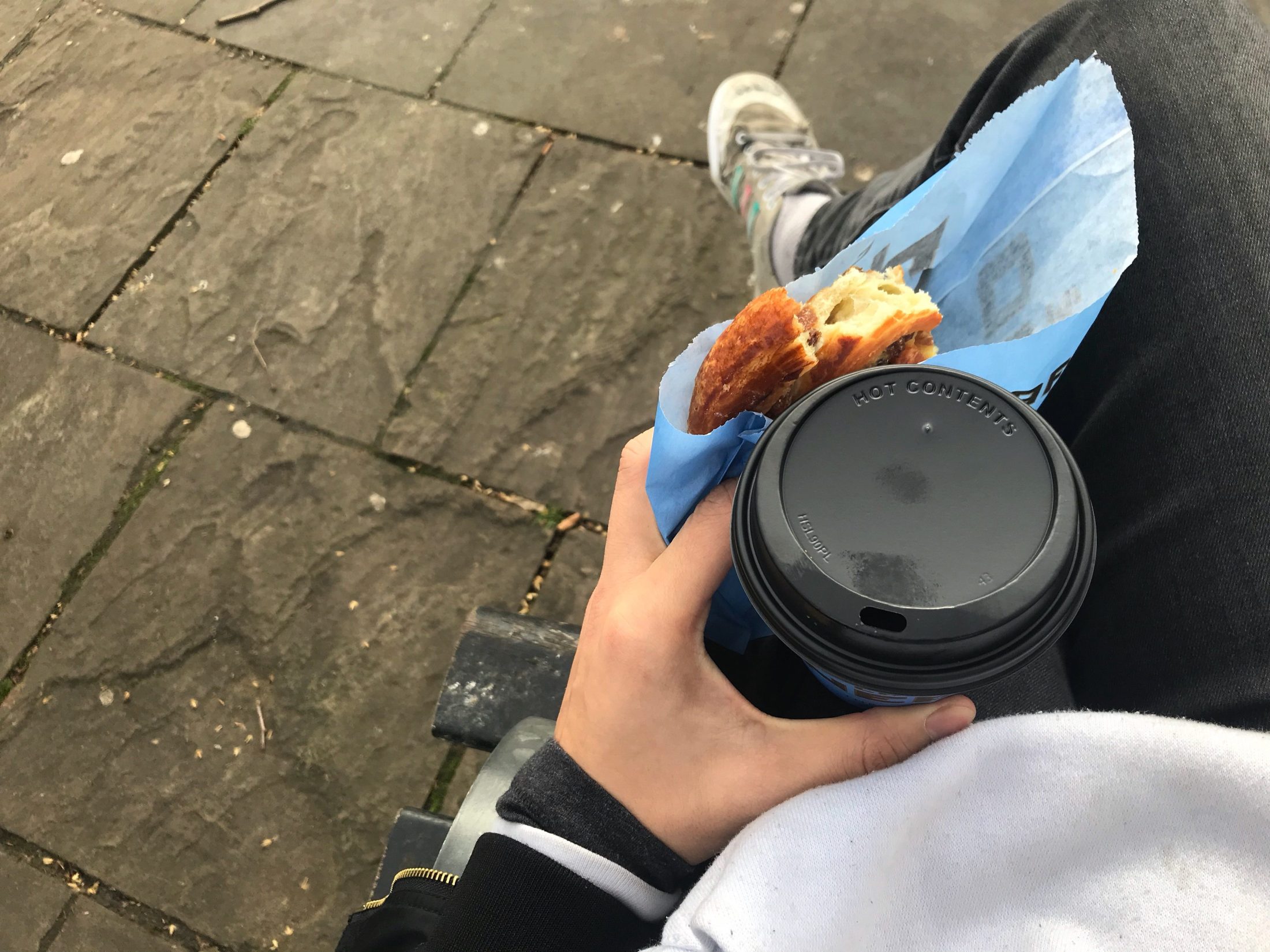
Arriving early for my Shakespeare lecture on 26 Bedford Way, I entered a nearby Cafe Nero on the corner of Woburn Place and bought an medium Americano and pain au raisin. The coffee shop had been unpleasantly full, and after failing to find a place to sit, I left the shop and settled on a bench next to a trash can in Russell Square, which was conveniently nearby.

During the summer, I enjoy sitting in the shade of trees. But today, it was still winter. The color of the air shifted from a blue when the clouds settled in to a warm yellow when the sun returned. When the clouds settled in to cover the sun immediately ahead of my field of vision, the familiar blue of the Cafe Nero coffee sleeve and paper bag complimented the colors of the air. When the clouds eventually passed by, the inner warmth of my coffee completed the comfort afforded by the titillating sunlight on my skin.

The butter found in the creases of my pain au raisin liquified upon contact with my tongue, leaving only its orgasmic juices behind. I rinsed down its languid taste with a wash of my coffee, letting the warm acidity cover ever surface of my mouth before taking another bite. For the first time in awhile, I had taken milk in my coffee. For the first time in awhile, I enjoyed milk in my coffee. The same thinness that had previously defined my state of existence to me no longer appealed to me. There, in the fullness of my pain au raisin and my coffee, I felt the wind against my skin.

The lid of the ‘rubbish bin’ adjacent to my bench had fallen off its intended location and hung tentatively by a metal wire connecting it to the body. The lid clinked predictably with the wind; by itself, the lid cannot move. Sometimes, the exposed material inside the trash can would be displaced by the wind. Sometimes, a few pieces of trash would liberate themselves from the confines of the trash can. A couple of packs of cigarettes, my used Cafe Nero bag, dripping cups of coffee, empty water bottles, dirty napkins, a carton of juice stabbed by a straw.

A variety of adults and children passed by me, each with their thoughts occupied by other ideas than those I have. A old man sitting on the bench across from mine on his phone. A mother feeding oatmeal to her child on another bench. Two men in their twenties feasting on their Tesco meal deals. A fat pigeon purring in front of me, flexing. An Asian couple also brought a DSLR camera to do a photo shoot, but for the first time in awhile, I observed them without judgement. They are a part of the world, just as a I am a part of the world, and who am I to place hierarchies on values?

It is in these moments that I appreciate to be alive. Lately, it has been hard to find those moments. But, at least, for now, I can say that I am comfortable with experiencing the continuance with existence. To be overwhelmed with beauty. To be alive.

becoming a piece of used tape

I have never feared change because I always viewed change as one of the few certainties in life. After all, I cannot fear a fundamental force of the universe the same way I could fear worldly fears centralized in respect to myself such as not living up to my potential or never truly understanding my truths. Without change, in my mind, the act of living would equate to a series of predictable cycles, not that there is anything inherently distasteful about living within the confines of repetition. But, to me, living without a constant embrace for the change that follows represents an act of injustice to the deterministic sequence of the universe.

The nature of change, however, necessitates that the act of changing pushes us further from our original nature, like original sin. Whatever the environmental circumstances or spontaneous insight that led to a desire for change, the new state of being can only reflect upon older drafts with an understanding of the chain of events that will constantly create newer revisions in internal and external manifestations of existence. The sequence cannot be understood until retrospectively constructed in adherence to previous conceptions of identity. Of course, until death recycles all memory of previous drafts back into the collective unconscious.

Cognizant of the inevitability of change, I, for a time, believed that my realization would allow me to live without the fear of the future. I had faith in myself that I would live true to my values regardless of the environmental circumstances that would affect my understanding of myself. Whatever changes I had made in my personal value — I convinced myself that any changes to my fundamental philosophies in life had been the result of me crafting a more well-rounded understanding of the world. I convinced myself that all of my experiences, no matter how difficult have shaped my future in unnoticeable ways, and I convinced myself that my experiences of suffering have been redeemed through its infinite causality.

Armed with an unfounded confidence in redeeming my experiences through changes in my convictions, I approached with the world without understanding the intangible danger of the continuance of living without intention. Because, while I can passively quantify my change through various interactions that I have had over the past two decades, I cannot observe my change through means that would allow me to evaluate whether the change I am making falls within the same values that I set out with. For every experience I have and will have experienced, the thought never occurred to me that some experiences pull me from the same grounds of existence I believe to be the most existent.

I thought that, fundamentally, I would remain the same person. I believed the part of my existence that cannot be quantified into “personality” or “identity” remained a part of my being immune to circumstance. The change I had conceptualized had been localized to the manifestations of my personality but not encompassing the core values that had been a foundation for the development of my tertiary values. The understanding that I change against my nature never even crossed my mind. With each continued experience point in my timeline, I further gravitate towards a universal conformity against the original insight that I had been born with. With each continued second, I fall closer towards equilibrium.

I fear the indifference that was alluded in Call Me By Your Name

We rip out so much of ourselves to be cured of things faster than we should that we go bankrupt by the age of 30 and have less to offer each time we start with someone new.

— André Aciman

It seems, to me, that I no longer have the ability to experience the vulnerability that had been a defining feature of my existence even a few months ago. Because, within my first two years of college, I had experience countless firsts that have occupied a vast portion of the formative experiences that shape how I conceptualize the world. It seems that I have very few experiences left to change the subjective truths I have come to realize. I previously had an urge to fill my life with as many new experiences as possible, and while I am still open to new experiences, it seems that I no longer have the same thirsting drive to gorge my life with as many “meaningful” experiences as possible. Such spaces have already been occupied.

Instead, I am left with a state of discontented discontentment.

I conceptualize the disappearance of my ability to forge new connections similar to a new piece of tape becoming a used piece of tape. When I had been a new piece of tape freshly cut from the roll of tape (i.e. when I had first come to college), I had so many spaces that had been unused, so many parts of my life that had been unexplored. I could stick onto someone else and share experiences with them while allowing them to ingrain themselves within my identity. But, when their flame leaves my immediate vicinity, as they do, they still leave their presence on the piece of tape that is the culmination of possible experiences of my existence. Although I am no longer sticking to them, they have permanently inhabited a part of my identity.

Whenever a space in tape becomes used, it could still stick — but never quite as well as before. The more objects a piece of tape sticks to, the more tenuous each subsequent stick becomes. The stronger the connection, the stronger the memory, the stronger the aftershock. Likewise, the more meaningful connections I forge in my life, the more insignificant they become with every additional connection. There exists only so many new experiences to be shared between individuals. Once those experiences are shared, they cannot be shared again with the same intensity. And after a while, with enough sticks, individuals become a used piece of tape, unable to stick to make any further connections. The glue that had been so unused and untouched has now been contaminated by the countless experiences of the past.

I wonder if I have become a used piece of tape. It seems so long ago when I approached novel friendships with wide eyes and a fervent desire to understand as deeply as possible. It seems so long ago when I could genuinely approach new friendships without hesitation. Of course, I would never shy away from potential friendships that would continue to fundamentally shape my perspective on the world, but it seems that I no longer approach with the same excitement as I have even a mere year ago. Or, perhaps I am lying to myself, and I am unable to create new friendships anymore. I have shared a few meaningful moments with a few meaningful people. They left. And now, here I am, continuing the same cycle of creation and destruction.

How many times could a piece of tape stick to an object before it becomes completely unable to stick to any more objects? Perhaps two? Or three? If so, I have already reached the threshold, assuming that my life follows the same patterns as a piece of tape. It would be quiet poetic, really. It only takes a couple of heartbreaks to change an otherwise idealistic view of love to a sinister and incendiary interpretation of the same ideas. A couple of heartbreaks would be appropriate given my age. I cannot, however, imagine how subsequent heartbreaks would do to my already cynical ideas. Perhaps I would learn to be more grateful. Perhaps I would come closer to a realization about the purest form of love, at least in context to the experiences I have been given. I would hope so.

Because I draw blurred lines in my definition of friends, as many people do nowadays, I treat the prospect of making friendships the same I would treat the prospect of entering a relationship. Including all ambiguous interactions that fall somewhere in between. The excitement that I once felt in within the beginning stages no longer defines my interactions. The uncertainty is no longer present. While I once existed in a state of confusion regarding every facet of expression, I no longer exist in the same state of confusion. I have, at this juncture of my life, more-or-less developed a general understanding of what I value in individuals. In correlation, I have developed an expansive list of superficial personality traits that qualify as red flags. As a personality, I have become less flexible.

I have met individuals who value similar parts of existence. Individuals, meaning that I will never feel a truly unique connection with someone ever again in my life. Individuals, only in the form of disassociated and coincidental identities. Those moments during the earlier phases in my life when I genuinely believed that I have met someone who understood me in a way that I wanted to be understood will never happen again. That formative moment in the first semester of college where I met someone equally as sad as I no longer seems like a special moment; there exist plenty of sad individuals in the world, and I have started and ended friendships with a number of them. I have developed a realistic understanding of my friendships, informed through my past experiences, and the apathetic reality frightens me.

I am changing evermore into a piece of tape. I approach new friendships and relationships with reticence, similar to how I used to approach potential romantic partners during the phase of seduction. I no longer relish in the uncertainty; formerly, it had been a defining feature of excitement that drove me to live my life in accordance to the value of consummation, but now, uncertainty just represents another debilitating force in the universe that compels me to act less lively than I had been previously. Every year that passes becomes exponentially more difficult to maintain relationships because every year that passes results in the accumulation of more fallen relationships. It is a fundamental fact of aging that I cannot change.

I wonder if I seek out certain individuals for my life in an attempt to establish the grounding of creating emotional pain when I could no longer create experiences of emotional pain without considerable emotional investment. Perhaps I have sublimated my inability to maintain relationships in the form of destructive beauty. The very nature of the strength of friendship depends on emotional investment, as well as a series of other factors. Without history shared between two individuals, all there could be is personality compatibility, and alignments in personality could never exist on the same degree of rarity as alignments in personal experience. It would seem that the act of creating friendships on a significant level is dependent on creating shared experiences.

Yet, it seems that I have reached a point in my life where I have become relatively good at creating friendships through accelerating shared personal experience. I have reached a relative maximum where, from a variety of experimentation in the past, I have identified which experiences would create the most amount of mutual intimacy in the shortest amount of time. I have learned to identify which individuals I am most compatible with on an existential level, and I have learned to engage with these individuals to find points of conversation that align the most compatible points of our personalities in the shortest amount of time. Unlike Tinder, whose structure encourages reducing standards for quantity, I have zeroed in on exactly which personal values I find compatible. And the cycle goes.

I wonder if I still have the capacity to feel the vulnerability that follows the fallout from a friendship. I wonder if there is any merit in pursuing any more friendships now that I have entered a state of existence where I no longer could feel the effects of creating intimacy anymore. I wonder if I should continue defining my life through the countless relationships that I have cultivated before coming to its violent conclusion. Such is the nature of the choice to continue existing. Especially in those moments of profound aloneness with the singular voice in my head, I continue to justify my will to live. To me, it is a simple choice: I either continue to accept that true love is violent, or I choose to die. The universe can be incredibly simple in that respect.

Such is the beauty of life. Such is the cruelty of life. Or, on second thought, perhaps the two are one and the same.

things that aren’t the same

Suddenly she felt a need to urinate. “You see,” she cried. “I need to pee. That’s proof positive I’m not dead!” But they only laughed again. “Needing to pee is perfectly normal!” they said. “You’ll go on feeling that kind of thing for a long time yet. Like a person who has an arm cut off and keeps feeling it’s there. We may not have a drop of pee left in us, but we keep needing to pee.

Milan Kundera, The Unbearable Lightness of Being

I take a piss before I go to bed. Sometimes, I would pee two or three times within the ten minutes before I fall asleep. I wish that I could fall asleep without peeing, but my inclination to pee sometimes consumes my thoughts as a compulsion. It seems, to me, to be more of a phenomenon of aging. When I had been a child, I would never pee before I go to sleep, and I would be fine. But now, as I continue aging, I could never return back to a state where I could go to bed without peeing. Not only do there exist physiological barriers that I do not understand, I have been conditioned to never return to a state where I could go to sleep without peeing ever again.

I treat some of the defining features of my personality with a similar lens. After certain experiences, I can never revert back to an earlier version of my identity in the same way I could revert back to an earlier draft of an essay. Regardless of the direction of the change, each experience changes our understanding of the world, which manifests through our construction of our own identities. Since our perception of ourselves are, by nature, defined through the events we have experienced (among other endogenous factors, I’m sure), each subsequent experience, no matter how disillusioning, could never be reversed after it has occurred.

The same could be said for the a priori construction of a relationship. Even though the concept of connection between individuals can only exist when the connection has been metaphysically idealized by other individuals, I cannot help but to believe that my relationship with other individuals exists within a collective unconscious regardless whether I can perceive it or not. Within my friendships, I have my own construction of my relationships, but beyond my own conception exists the true conception that I cannot perceive given the limitations of my ability to conceptualize. And because the existence of the relationship, according to my faith, exists beyond my perception of it, I find it deeply unsettling and comforting that each incidence of experience is recorded within a archive outside of my memory.

The same way I could never return back to time in my life where I could go to sleep without peeing, I could never return back to an earlier time in a relationship when I have not the set of experiences that have given me a more disillusioned view of the same relationship. It only takes a couple of minutes to retrospectively redefine my entire conception of a relationship, and I have certainly been through a couple of couple of minutes. Even though I should holistically conceptualize my connections to others disregarding a specific incident to define the entirety of the course of a relationship, I, as the imperfect being I am, sometimes can only reflect upon a relationship through the ending couple of moments. Those moments, like an edit that cannot be reversed, spoil the entire document without the prospect of revision.

Each book that I read fundamentally changes the way I look at the world. Each conversation I have fundamentally changes the way I look at the world. Each cup of coffee I drink fundamentally changes the way I look at the world. Some more than others. As an amalgamation of all the experiences I have ever had in the past, the references of causality that create my identity could be infinitely quantified to be linked towards an aspect of personality that I have. Some of those aspects of occurrence I can articulate. Some only exists within the collective unconscious as a series of intangible and imperceptible object of encoding that will never exist again in the sense that after I die, there will be no one left to observe these thoughts, even if indirectly.

I can convince myself that I control some aspects of my life. I can convince myself that friendships are the results of a series of choices to continue to make sacrifices and nurture. I can convince myself that the words I write on a page are those that I deliberately chose from the inner recesses of my mind, that the thoughts that I have are mine and mine alone. But, realistically, I am affected by my environment. More than affected; I am the series of effects by my environment. To say that I am more than the effects of my environment would invalidate the nature of my existence. Thoroughly questioning the fundamental beliefs I have about the universe at this stage in my life would probably cause me to end my life. And so, as long as I hold onto subjective beliefs as universal truths, I still have a reason to live.

I wonder if there is any semblance of how much misery I chase in my own life. Although there are parts of me that act instinctually, partly due to the countless other experiences that have evolved to the state of a cause within the progression of my tenure as an existent being, I wonder how many of the decisions that I have consciously weighed out within my mind are the results of me justifying pre-ordained decisions by my body through a series of logical arguments constructed by my mind. I wonder which came first, the logic or the decision?

It would be easy to realize how some of my self-destructive tendencies have caused me to make certain decisions during certain periods of my life; it is even easier to realize which experiences of my childhood had contributed to the formation of my self-destructive persona, but the act of pursuing misery for the sake of pursuing misery — I venture to question myself on how much of my everyday actions are the result of an unconscious desire to seek experiences of non-physical pain when I have experienced an otherwise absence of self-inflicted physical pain in the past few years. But, as it always is, once the knife touches, it cannot untouch itself. The fundamental fact is that there is a difference between the touch and the untouched.

I despise the nights when it’s lonely. I despise the mornings when it’s lonely.

It’s lonely. It’s always. So. Lone. ly.

I yearn for the morning to escape the night. I yearn for the night to escape the morning. But, sometimes, in the middle of the day, I feel content. I forget about the loneliness I feel during the nights and morning. I feel… not, not unhappy. I forget to forget. Those moments mean the world to me, partly because they truly create the world. Otherwise, I really am what I say I am: a shallow pool of melancholy dirtied with some forgetful moments. But even so, it seems that such solace only come temporarily. As life continues, I will find new ways to be unhappy. And, despite all my effort in creating systems where I can minimize unhappiness, it seems that sadness slowly creeps back. Irregardless of me, sadness creates itself.

But, here I am, once again writing in the dark. I know it won’t be the last time. As long as the nights feel lonely, it will never be the last time. It’s how I sleep, if I can sleep. Because, it seems as though there will never be a time in my life when I could sleep as well as I did when I was a child, when my stresses consisted of a short list of solvable problems. I miss those times, and doing so only hurts me even more. I wish I could return to a time where I could sleep like the proverbial baby. I wish I could relinquish the experience that I have accumulated. Doing so would allow me to return to a state of happiness, a state of forgetfulness, a state of unreality. Because, even as I am approaching the truth of it all (or, at least, what I consider to be truth), it seems as if the closer I creep, the more fearful I become, the more I wish that I had never seen the sights I saw at all.

I feel lonely, like I always do. I feel like I have no friends. I feel as if I only surround myself with people that will leave in a matter of time. I feel as if nothing is permanent. I feel as if nothing should be permanent; the concept of forever only causes pain when it becomes inevitably clear that friendships, especially, are not permanent. I feel as if I have ruined friendships that could have lasted. I feel as if I will continue to ruin friendships that could have lasted. I feel as if being alone is a part of my personality. I feel that I should feel wrong about that. But I don’t. I don’t feel wrong for the supposed wrongs that I have done. But I do feel wrong for not feeling wrong about my wrongdoings. Because, without guilt, I would feel happiness. And how could I allow myself to feel happy?

Like the arrow on the FedEx logo, I cannot help but to notice and never unnotice the trends in my life. The same cycles, cycling. And cycling. And cycling. I should break the cycle, I would tell myself. And I would try. And try. And fail. And it cycles. Cycles. It continues to cycle. And cycle. And no matter how many of my bones are crushed by my futile attempts to cease the wheel from cycling, it continues to cycle. And cycle. And the cycling haunts me. The shriek of the wheel turning at night keeps me from sleeping. It’s my guardian. My reminder. It’s the underlying cycle that propels every aspect of my life. My vitality. Life. The drip of water. On the dirt. Buried.

another birthday, another question

I spent my birthday, appropriately, in the Caffe Nero near the Euston railway station, quietly, sipping on a shot of espresso and reading The Myth of Sisyphus by Albert Camus.

Marking another year’s observation of my experience within the deterministic timeline of the universe, I once wrote that I found my birthdays to be a deeply saddening. As a moment in time that almost invites reflection, I cannot help but to wonder about the countless identities I could not create within the past year. While reflection sometimes leads to epiphany, most of the time, acts of introspection tends to lead me to sadness. My birthday is no exception Because, to me, it is a countdown. Ever since I was born, every subsequent birthday marks another realization of all those possible futures I have crossed off in order to realize my current one. And, for someone who dislikes their personality as much as I do, the idea that I can only converge towards a more fine-tuned version of my personality disappoints me.

If I could construct the entirety of my life as a deterministic narrative, I would probably classify my life within the genre of a tragicomedy. Similar to Romeo and Juliet by William Shakespeare, the first couple moments of my life were defined by a couple of minor altercations without forethought. Initially paralleling the structure of comedy, I had been convinced that the difficulties within my life would eventually lead to a moment of gratification, traditionally signified within Shakespeare’s works in the form of a wedding. Similar to the conception of the audience watching Romeo and Juliet for the first time, I expected the ending of my life to have a similar source of gratification because I had already classified the work following defined structure of Elizabethan comedy.

Only halfway through the play, however, does that audience of Romeo and Juliet realize the fault in their preconceptions. Within its temporal context, comedy did not contain elements of tragedy the same way tragedy did not contains elements of comedy. Mercutio, serving the role of the jester throughout the play, is slain by Tybalt. The event cascades to a series of other events that eventually lead to the suicides of Romeo and Juliet, warping the comedic themes of the play into a definitive tragedy. Reflecting back on my teachings of Romeo and Juliet, I wonder if I, too, have reached the epitasis of my life. I wonder if I have made enough wrong choices in my life where I can only observe my life culminating to my story’s ultimate catastrophe. Of course, such questions can never be answered.

The other week, my friend brought up the concept of “UCLA Grant.” It’s self-explanatory: it’s the version of me that would have gone to UCLA instead of Penn, a version of me that would have consecrated into existence given a different mood by an admissions officer. It is only a potential version of me that I can only imagine, and given the fundamental paradox in statistical learning, I can only speculate given my impressions of the environment that has shaped me to become the way I currently am. The decision goes back to senior year of high school when I had dedicated the past 18 years of my life in the hopes of getting into a prestigious university. My final decision had been between UCLA and Penn, but it wasn’t really a decision that required sacrifice. I did not care much for which college I attended as opposed to which college I had been accepted.

I wonder if I would have been happier. I wonder if I would have the same attitudes towards happiness that I have now. Certainly, much of my sadness had been accented by the malignant culture of Penn, but I have no way to ascertain how much influence my environment had over me. Even as I am studying at an entirely new university in London this semester, I still feel the same negative emotions that have defined my life. When I meditate upon the events of my life, I can recall so few times when I experienced a state peripheral to a constant submersion in sadness. Even if I take a deterministic lens, it almost seems as if my sadness remains the only facet of my existence that emerges immune to the environmental influences of the universe. To me, sadness is the only certainty I have come to know.

Perhaps, the nature of my sadness isn’t so much a regret over the events in my life happening in the way they did but a yearning for the potential timeline in my life where I imagine myself living joyfully my existence as opposed to the gloomy existence that has defined my life until now. My desires to live a life other than my own is no way indicative that I crave happiness; I find any emotion ungraced by sadness to be repulsively unreal. Even so, I wish sometimes to leave my existence behind, to enter a state of genuine loneliness and relinquish all that I have created over my tenure as an existent being contributing to an intangible universe. If the will to live is defined by a constant grasp of a piece of thread, then I just want to let go.

After reading the last paragraph of The Myth of Sisyphus, I could not help but to wonder how Sisyphus could smile in the face of the absurd.

I leave Sisyphus at the foot of the mountain! One always finds one’s burden again. But Sisyphus teaches the higher fidelity that negates the gods and raises rocks. He too concludes that all is well. This universe henceforth without a master seems to him neither sterile nor futile. Each atom of that stone, each mineral flake of that night-filled mountain, in itself forms a world. The struggle itself toward the heights is enough to fill a man’s heart. One must imagine Sisyphus happy.

Albert Camus, The Myth of Sisyphus

I take comfort in thoughts regarding suicide, not that Sisyphus ever had the option to commit suicide. From my experiences, it seems that individuals attempt to avoid thoughts regarding suicide, but I never quite understood how some individuals could be so willing to discard such a defining feature of being human. After all, when is the last time we have seen an animal commit suicide? Thoughts of suicide exist regardless of whether or not we wish for them to exist. Similar to the act of loving, we can never suppress a thought so fundamentally human as suicide no matter how strong our mental fortitude. Even the mere attempt of suppressing thoughts of suicide can only bring stronger thoughts in return. To live without thinking about suicide — how would such a mundane existence qualify as living?

Because I have metaphysically caused my thoughts into existence, I have more power than my thoughts. It would follow that I exist on a higher tier of reality than my thoughts. As long as a continue to exercise power over my thoughts, then my ruminations would never tangibly affect my existence. It is as Camus phrased it: “Rarely is suicide committed through reflection.” I can reflect for as long as I wish, and my thoughts can exist within my reflection for as long as wish until, of course, I wish them to cease to exist. That is, assuming that I have control over my own thoughts, which often I do not. But, even if my life is dictated by those thoughts that pass through my consciousness, my thoughts will only continue to exist for as long as I decide to live. Such is the power dynamic between me and my thoughts.

It seems the more birthday I have, the more alien I feel relative to others. I remember my times in elementary school defined by my ability to become friends with anybody. There existed so little to cause friction within the inception of any friendship. I could become best friends with a complete stranger within minutes of acquaintance. I had not yet experienced the formative aspects of my life that have shaped my personality, and before those moments, all interactions seemed to be created equally. The idea of compatibility seemed limitless; who was I to dictate whether someone qualifies as my friend or not? Being an only child at home with clashing perspectives of intimacy, I just wanted to convince myself that I had friends.

It seems so long ago when I still made an effort to create friendships. It seems so long ago when friendships could be created without a thinning set of criteria mediating its progression towards eventual filtration. It seems that my rules for selecting individuals I willingly spend my time with become evermore strict, that I am constantly searching for reasons to end friendships when they do fit the paradigm I have created as a reflection of the perhaps unrealistic values I have for myself and others. Even the mere act of meeting new individuals invites me to taste the unrealized bitterness of my saliva. I can only conceptualize individuals relative to their perceived compatibility relative to me, and every year, it seems that I become less compatible with the world.

If I die, I wonder what happens to the remaining traces of me. My writing will disappear with me, as my blog is linked to my credit card, and I will no longer be here to pay for the bills that accumulate each month. So it goes, the impermanence. Even art, the most real aspect of my life, will disappear in a short amount of time after my death. And, without an extension of thought to metaphysically cause my existence, I will cease to exist. My life, defined through ebb and flow of hopelessness, will no longer be a part of the world. No tangible extension of my existence will continue to be a part of this world, which continuously feels less and less the world that I have come to know all of these years. This other world — I cannot imagine that it would ever feel familiar ever again.

I would used to wonder why my birthdays felt so saddening to experience. Growing up within a society with such a strong emphasis on birthdays as a day of happiness, how could I, as someone who has experienced so much privilege in my life, experience sadness when I have so much reason to be infinitely grateful? It would be difficult to convince myself of the same opinions nowadays. Given the formative experiences that have shaped my conception of the world, I wonder the opposite: how could individuals truly be happy on their birthdays? What reason could they possibly have to cherish their existence? It would almost feel as if they were glad to be alive.

What a feeling… to be glad to be alive.

metaphysical idealism, tiers of reality, and the captivation of social media

Every morning, on the way to one of my favorite coffee shop in London before classes, I come across a graffiti message scribbled on the wall of a bustling intersection between Euston and Hampstead, which reads:

FRENCH RIOTS GET RESULTS!

U LOT ARE INSTAGRAM ZZZOMBIES

I vaguely have heard of the riots in France that started over gasoline prices from the daily briefings from the New York Times, but I have gathered a rather negative sentiment towards them according to my immediate vicinity of individuals that influence my thoughts. Nevertheless, I found the quote quite provocative. The riots in France, relative to my existence, can only be abstracted through a source of news. Because I have not been nor have the intention to go to France since the riots have started, I can only conceptualize them through news headlines of the news sources that I read. It is an other to me; this is my existence, and that is their existence.

Sooner or later, the riots would follow a predictable set of events. If the French government utilizes too much force to put down the riots, then the world media would criticize the French government similar to how the criticized the Chinese government after the Tiananmen Square protests in 1989. In the French government does not utilize enough force, then the country could potentially descend into chaos and become a failed state. If French government remains complicit to foreign intervention, then the regime could be overthrown by CIA-backed rebel groups like Libya after Operation Odyssey Dawn. There exists countless possible scenarios, each with their own historical precedent, but each of them would follow an unsurprising set of events.

Sooner or later, regardless of which path the French government takes, the news would stop reporting on the French riots, and I would stop thinking about them. Sooner or later, the thought would completely escape from my memories, and I would continue to live my life with a new event that remains in abstracted through my limited conception of the world. The world may happen around me, but I exist in a state of privilege where I could be isolated from the events of the world if I choose to be. I remember that Syrian civil war had been the topic that defined international relations during my time in high school. Because I have not been exposed to any new information regarding the Syrian civil war for some time now, my abstraction of Syria exists in the past. But, unfortunately, just because it exists in the past for me does not mean that it exists in the past for the countless refugees and soldiers who are still involved in the conflict.

To me, the Syrian civil war is just a concept because I have never observed the conflict. I have never been to Syria throughout my entire life, and I cannot even come closer to understanding the conflict except through news articles with an occasional scholarly source from a peer-reviewed journal. But, because the universe exists more than through my perception, the conflict in Syria is still undergoing regardless of whether the thought of the conflict occurs to me. There exists the objective state of the world that is marred through conflict, and then there is the reality that I have come to observe through my immediate perception and categorization of stimuli. All abstracted events understood through the news follow the same cycle.

I certainly care about any conflict in the sense that it does not bring me happiness when I hear that millions of individuals have either been killed, displaced, or imprisoned for reasons beyond their control. But it would be an insult to say I cared about the conflict with any justice to the true meaning behind the intention of caring. I am not invested in the conflict, and I have not sacrificed my life towards any cause. If the Russian plane bombs a hospital in Aleppo killing hundreds of individuals, it does not affect my life. I would be saddened to hear about death, but, sooner or later, I will move on with my life. If on the off-chance, France devolves into a civil war, I would be directly affected slightly in the sense that I can feel its macroeconomic effects on the US economy. But, realistically, I am in a position where I have the privilege to continue to be indifferent.

I cannot even think of the last time I attended a protest for a cause I genuinely believed in. I had attended a protest in sixth grade for bringing attention to the Syrian civil war, but mostly because one of my best friends had asked me to go. Sometimes, I enjoy thinking about the world in the framework of vague topics in modernism, aspects of literature that only exist in the realm of literature but have no tangible benefits to society. Of course, the benefits of the humanities cannot be measured relative to contribution to GDP, but I still find it deeply unsettling that the vast majority of my thoughts on understanding my own life exists completely abstract and unaffected by society. The French riots can happen around me. The Syrian civil war can happen around me. Nevertheless, my thoughts can continue to be unaffected.

I can perceive my thoughts. But, at the end of the day, my thoughts do not exist on the same plane of reality as the actual happenings in the world. If I die, my thoughts die with me. On the other hand, the various conflicts in the world do not depend on my existence to exist or not exist. It is because the happenings of the world are very much real despite my ability to perceive them. While I can only perceive events outside of my immediate perception in the form of abstraction, the events truly exist in a state outside of my abstraction. I can convince myself that conflicts around the world are not really happening because I can convince myself that my abstractions are not real, but that does not change the true state of the world.

According to Berkeley, a tree can only fall in the forest if there exists someone to perceive its falling. Otherwise, outside the realm of abstracting the state of the world into an idea, then the world does not exist in an uncategorized state unconstructed by individuals with the ability to construct. It would imply, by the same doctrine, that the amount of reality an attribute of the universe would have would also be dependent on the amount of ideal constructions that metaphysically cause the attribute. And, because I can only observe objects within my immediate perception of the world, within my subjective construct of the world, the amount of reality and object has is causally dependent on the complexity of my ideal construction of the object.

Even so, I would not ever be able to justify to myself that the world that exists within my immediate perception could be understood as something that is real. There are plenty of facets to my existence that do not accurately reflect my optimal distribution of reality according to my values. Because I am imperfect by nature, I can only distribute my attention to ideally construct ideas and objects relative to my instinct that is reflective to my subjection of various aggregately constructed aspects of society that are, by nature, are less real than me because they are causally constructed by me and countless others, but also, on the contrary, possess more metaphysical power to cause than me.

Some constructs can be intuitively understood: justice, love, religion, etc. Such ideals can drive individuals to act in the name of an ideal as opposed living in the absence of an ideal. Even though ideas are constructed by the society constructed by individuals, they still have the ability to affect the same individuals who caused their existence. If all humans were to perish off the face of the earth, then any construction by humans would cease to exist. Such is the nature of metaphysical causality. Yet, how can I articulate an explanation for the ability for aspects of society that are less real to exercise metaphysical power over the same individuals who supposedly have more metaphysical good than the ideas they supposedly caused?

I wonder which of my actions are performed in pursuit of a constructed ideal as opposed to an exercise of free will. As someone who used to pursue the ideal of happiness, I wonder which parts of my life truly bring me happiness; I wonder which parts of my life have I convinced myself to bring me happiness due to my education by the culture industry of what should cause me happiness. It is yet another example of a construct created by the ideas of countless individuals throughout time to now influence my actions and my perceptions. Perhaps it is those individuals who influence me as opposed to the ideal they created who influences me. But, as someone who also perpetuates the validity of an idea unto others, how can I know for certain the direction of causality?

Some of those aspects of my life I could identify and categorize within the binary of causing or being caused, but the mere act of identification and classification is not sufficient in terms of escaping from this pillar of society. Just because I could identify the issues that cause me unhappiness in my life does not mean that I can control my life to the degree of escaping from them. The culture industry, among others, is the cause; I can identify the cause; I cannot erase the cause. Because I cannot escape from the cycle of causality even after identifying the nature of the cause, it seems to me that I am powerless to influence the actions of my own life, especially relative the ideas that have less reality than me but also have more power to influence attributes of existence that are more real.

Events from around the world come and go in my life relative to what the media chooses to bring to attention. My social media use, on the other hand, is not subject to the same cycle that defines my attention towards various happenings around the world. Since fifth grade, when I created my Facebook account for the first time ever, I cannot imagine living absent of the identity I have created online. Even when the idea of social media is not in my immediate consciousness, its influence within my unconscious pervades every point in existence in the sense that I can construct almost every aspect of my life relative to the value of social media in my life. I would find it hard to convince myself that I could live completely free, even when I perceived it so.

For a long period in my life, I have convinced myself that social media could potentially be used as a source of happiness. I thought that the act of staying connected to individuals who would otherwise not remain in contact given the absence of technological advances marks a transcending viewpoint to justify my continuous use of social media despite my apprehension in opening my folder of social media apps at any given instance. Although my sentiments back then are not false per se, I do believe that my viewpoints had neglected the integration of social media platforms within various facets of the social identification of perceived happiness. It is true that I can stay connected, but I would find it hard to believe that I am genuinely staying connected to the individual, as opposed to the idea of the individual.

Similar to news headlines, social media posts cannot communicate reality; they can only offer an abstraction of reality to fit an imperfect mean of communication. If we do not observe the individuals in social media on a regular basis, the only form of reality we can operate on is an abstraction of an abstraction. Each post goes through two waves of idealization: 1. The person who performs an action on social media must internalize the sentiment they wish to communicate, and 2. Their sentiment of communication must be internalized by us through another mode of internalization in order for us to observe. If each wave of idealization decreases the validity of the a priori state of reality, then abstractions created through social media exist on one degree of reality less than perceptions created through immediate observation.

That is not to mention the effect of the culture industry on our choices that contribute to the selection bias that further decrease our interactions on social media in terms of realness. If we act in accordance with an ideal (for example, the perception of being happy), which is already a tier fo reality below the reality that is not abstracted into idea, and then we further add more filters of idealization, then the end product created by the platform of social media has been diluted through so many levels of abstraction that I could hardly consider it to be real, not that there is anything inherently wrong with living in a reality that is not as real as the unabstracted version of the world.

Although my usage of social media has changed over time, I still open the same apps with the same degree of reluctance in every instance. Being aware of the irony of flaunting money that is not mine to flaunt, I no longer use the app to show off my extravagant expenditures in food through my stories or my exaggerations of my knowledge of pop culture through the concerts I attend or my pretentious identity as someone who travels the world through the pictures I post. Such actions, I now consider, to be undeserved expenses that should not be celebrated as a means to demean others with fewer opportunities to be materialistic. Instead, I now use social media as an expression of an idea: that sadness is beautiful.

Also, that I hate colonialism.

My use operates on the same level of abstraction, but somehow, to me, it feels more real than the presence I had previously, which had been largely limited to the materialistic highlights of my life. It feels as if I have lessened the thickness of the filter between the actual state of my life and my perceived state of life. It seems almost a defining feature of social media — to portray a happy persona — but I can say with almost certainty that life is defined through a continuous stream of happiness. No one’s life is defined through a constant stream of happiness, and if it is, it is in accordance with my truth that they are never living at all. My life has not been happy for awhile, so why should I convince others that it is?

I can sympathize with the word choice: INSTAGRAM ZOMBIES. There is the content on social media that I create, and then there is the content that is perceived by others. Sometimes, it feels as if there is a leaky bridge that causes the majority of what I say to fall off the side before reaching the other end. Sometimes, it would feel as if I were screaming into the void, only to hear my echo. I would make a post on Instagram detailing exactly how I was unsatisfied with my life, hoping to change the landscape of a constant overflow of happy content, and all that would happen is that I would receive likes, the overwhelming majority of them by individuals I have not spoken to in the past year.

Even the mere nature of social media is driven by a desire for validation. The mere concept of the like is an abstraction of the communication of validation. Oftentimes, the act of liking feels transactional. The logic goes: if I like your photo right now, then you will like my photo later on. Sometimes, the act of liking is thoughtless; some of my friends would like all photos they see in hopes of maximize the number of likes they receive whenever they would post a photo in wait of validation. In such cases, I find it deeply ironic that the act of liking has been abstracted to so many degrees that the original intention behind the term like is no longer a thought. Photos are not liked because they are liked; they are liked for the sake of liking.

I remember, when I first started to use Facebook or Instagram, I would be friends with individuals and follow individuals without even knowing the person in real life ( in this case, I am referring to peers, not celebrities). I would like their photos whenever they would post a photo, and they would like my photo whenever I would post a photo. I wanted friends and likes on my photos to communicate that I was “popular,” and it would be well within each of our incentive structures to maintain such an equilibrium. Such a relationship would be completely devoid of intimacy and completely defined transactionally through something as unreal as social media. Likes on photos without even the sentiment of liking.

I remember, when I first started to use Snapchat, I had been obsessed with creating streaks in order to accumulate Snap points. I remember tallying my points at the end of each month how much pride I had felt when I increased my points from 4,400 to 160,000 in a matter of a year. I remember the hours it would take, just opening my phone and sending pictures of a face back and forth to my 40 streaks between the hours of 5 and 11 p.m. every day. I remember how I used to consider my prowess on Snapchat to be one of the greatest accomplishments in my social life. I used to consider my streaks to be proof of my ability to maintain relationships. But it’s been a couple years — how many of those 40 streaks do I still talk to?

I have since deleted Snapchat. Where are my points and streaks now? I tend to think that my faith in Snapchat points and streaks follow the same laws of currency. The value of any currency is dependent on the faith that I, as a collective, put into them. It is intangible, like a concept, similar to the ideas in modernism that dominate my thoughts. Unlike modernism, however, principles of economics dictate my life in tangible ways. I am limited by the absence of money, and I am liberated by the having of money. I used to define my value through my possession of streaks, so I had faith in the value of streaks and points. Now that I do not have my faith in Snapchat anymore, the points and streaks that used to be real are no longer real.

As someone who did not receive validation for much of his life, I craved the validation afforded by my use in social media. But, like any other facet of life, I soon found that my desires were rooted in deep-seated unhappiness that could not be addressed through social media. If anything, the constant cycle of validation and inadequacy creates a positive feedback loop that furthermore increases the difficulty of escaping from the cycle perpetuated by the culture industry that is the abstracted form of existence that is social media. Wanting is caused by dissatisfaction. The need for validation is caused by wanting. Further wanting is caused by the attempt for validation. Soon enough, that is all we have come to know.

It is only now do I feel as if i have fully made sense of Bing’s Speech in Black Mirror:

Cause we’re so out of our minds with desperation we don’t know any better. All we know is fake fodder and buying shit. That’s how we speak to each other, how we express ourselves is buying shit. I have a dream? The peak of our dreams is a new hat for our doppel, a hat that doesn’t exist. It’s not even there, we buy shit that’s not even there. Show us something real and free and beautiful, you couldn’t. It’d break us, we’re too numb for it, our minds would choke.

“Fifteen Million Merits”, Black Mirror

Thank you, unknown graffiti man, for pointing out my existential enslavement to an idea.