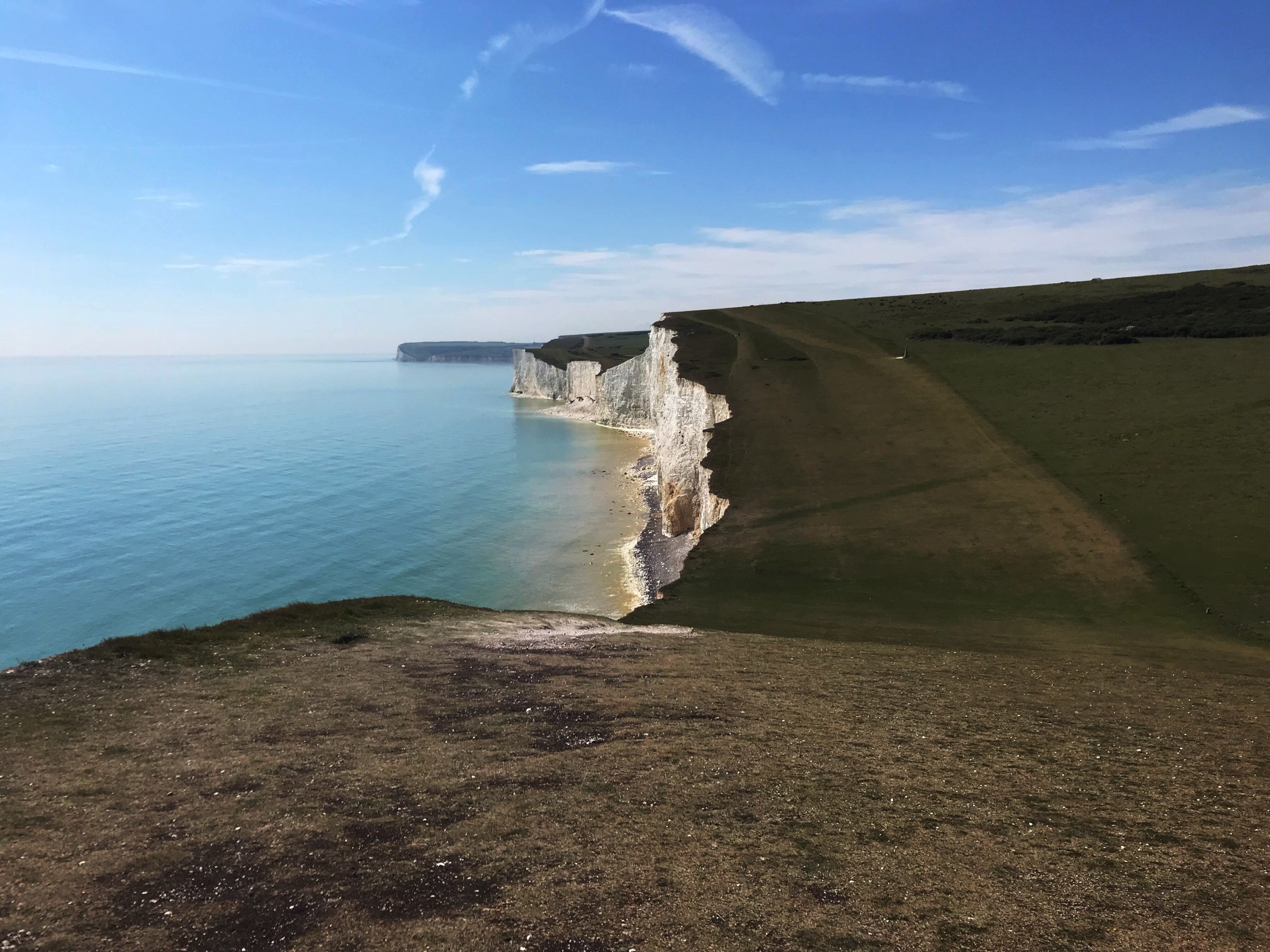
the seven sisters

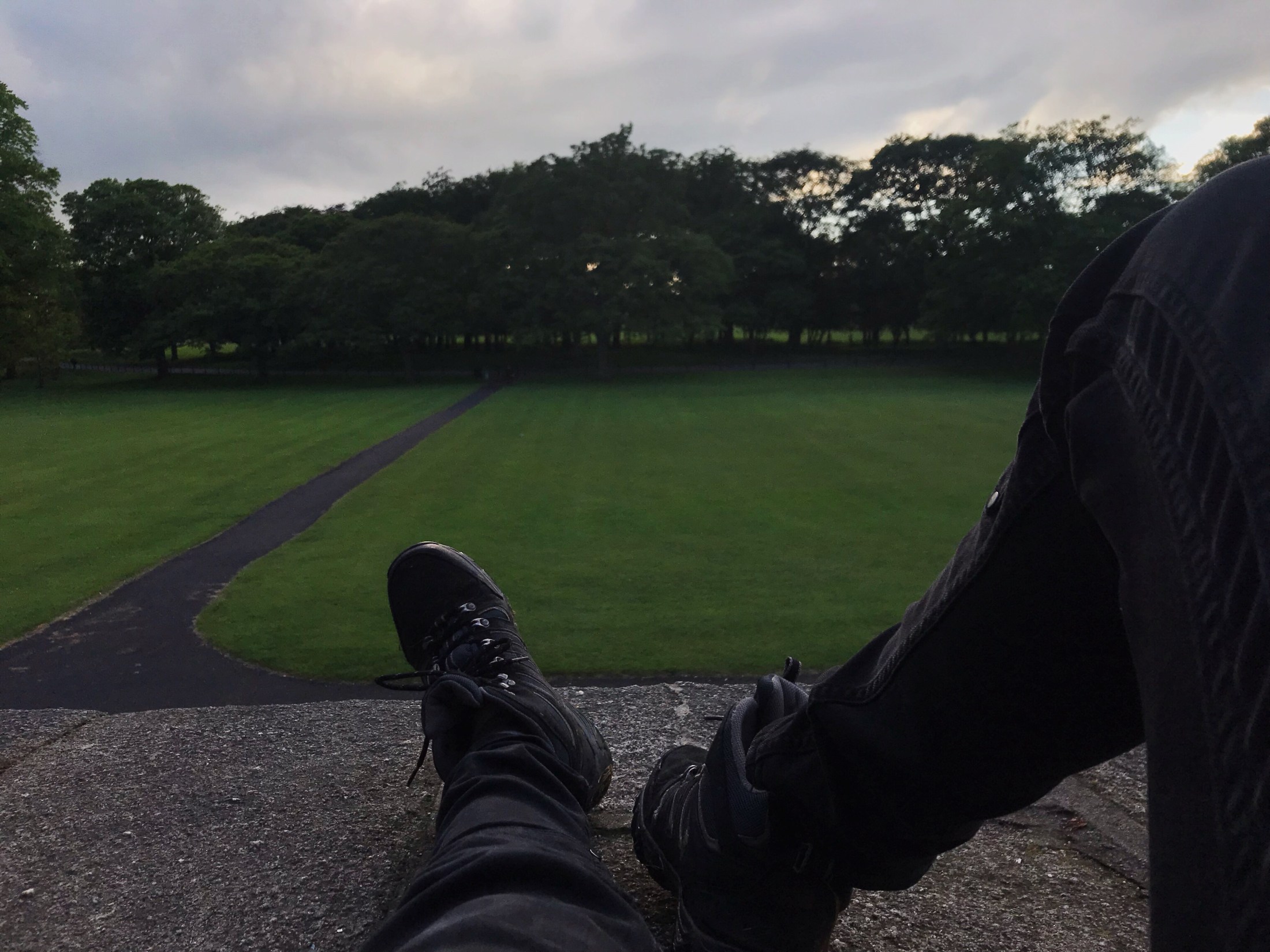
I spent my last full day in the UK, appropriately, hiking the Seven Sisters trail from Seaford to Eastborne. It was quite a risk. I had run out of cellular data on my phone, and my flight had been the next day back in London Heathrow. But, this had been a trail that I had missed out on previously. This was a trail that I wanted to see. Even Caeser saw it on his attempted conquest of England. I was determined to see the chalk cliffs of the Seven Sisters before I leave the UK, and I was willing to take a series of reasonable risks in order to do so. And, here I am, writing my thoughts after the hike viewing the sunset from Eastborne.

It was an overcast day. The temperature was warm. There was a cool breeze. Then it turned sunny. I hate the sun.
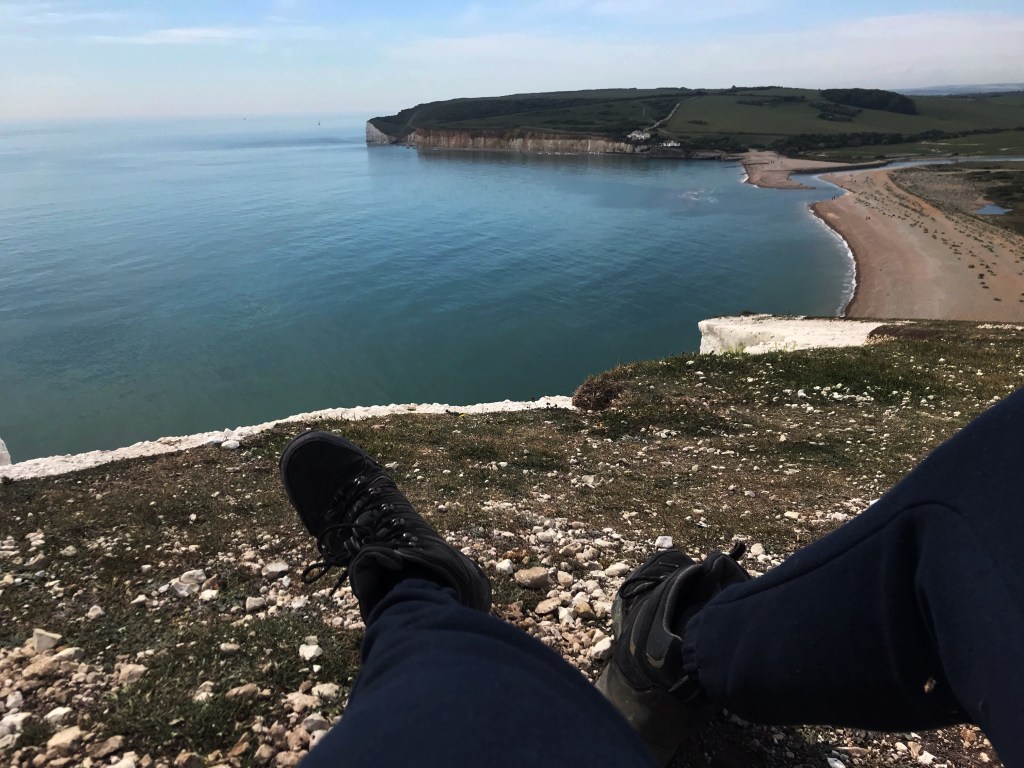
In terms of ideal hiking weather, this is as ideal as it gets. My train to Seaford had been quite confusing. My ticket had indicated a transfer at Lewes. This, I had expected. But, midway through my ride, it was announced that my train would be split into two. Luckily, I realized in time and picked the correct half of the train that would lead to my destination. If I were to have been two carts down from the cart I had occupied, then I would have gone onto another train to a destination that would have certaintly have made me lost. And, who knows if I could make my flight back to Philadelphia the next day. Such is the determinant.

To say that my walk was leisurely would be a lie. I took a couple of water breaks, of course, but my breaks never exceeded a minute. Throughout the entire hike, I kept on checking my location on Google Maps. I did not keep track of my pace, but it constantly felt as if I was behind schedule. Especially before what I considered to be the halfway point, I kept on feeling as if I wouldn’t make it by 8 PM, so I did not take any significant breaks from the the moment I had started. Sometimes, I would stop to admire the view, only to realize that I do not have enough time to admire the view and continue marching.

I thought about a few things as I walked.

Sometimes, I would smell the sea breeze and be reminded of crying. There are so many instances of me crying while growing up, and I remember the smell very distinctly. Because I have no cried since, I only can rely on my memory, but there is no way I can mistaken the salty taste in my mouth that swells through my throat and into my nose. Perhaps the ocean is just a giant tear. There is plenty of sadness in the world that would allow someone to shed as massive of a tear as the ocean. Perhaps it is divine in this rite. I have always sought justification to view the ocean as a divine entity; perhaps this is it.

The ocean was blue. It was a shade of turquoise. There was a minute where I could see the flora underneath the ocean about a hundred feet away. There is something about cliffs and oceans that magnitizes me. They are both products of nature. But, there is also a force that i have been attracted to since I was a child. It is just a cliff, and it is just an ocean. But, to me, it is so much more than that. It is possibility, particularly, the possibility of dying. I could fall off a cliff just as easily as I could drown in the ocean. And, especially being in the presence of both, I frequently fantasized about dying.

The birds would also chirp from above. I was not wearing sunglasses, and the sky would be too bright for me to look up. I would hear de-localized chrips echoing from the sky. It is the beautiful sounds of birds wanting to have sex. Or socialize. Do birds even socialize? To me, it is just a series of sounds to which I have assigned a label of beauty. A couple of miles later, I saw cows in a field. The cows were at least a half a mile away, but, for some reason, I could hear their moos all the way from the trail. I have been quite used to noise pollution all of my life, so I found it quite jarring when I could hearing such noises from so far away.

Sometimes, I would look into the horizon between the sea and the sky. Since this is the UK, the sky was cloudy, as usual. It was also foggy. But, the sky today had a blueish tinge to it. When I would look at the horizon, sometimes I would be unable to realize where the sea turned into the sky. With the gradient offered by the fog, it seemed that the two were one and the same. I found the moment to be beautiful. Here I am, standing on patch of green, while the rest of the world is a shade of blue. In terms of capturing the feeling of alienation from the world, I thought the contrast was riveting.

At one point, I was near tears. I say near because I am pretty convinced at this point that I no longer have the capabilities to cry. It was the moment that I came to realize that objective beauty did exist. I had been hiking for a little bit, and I turned back to look at the town of Seaford from on top of the cliff. While I have attempted to explain my feelings for my entire life, it was a moment that I could not fathom. At least, right now. I might be able to explain it later. I was so detached. So isolated. For a moment, it seemed that I truly had a purpose to live other than instinct. It was a feeling. I have forgotten that feeling.

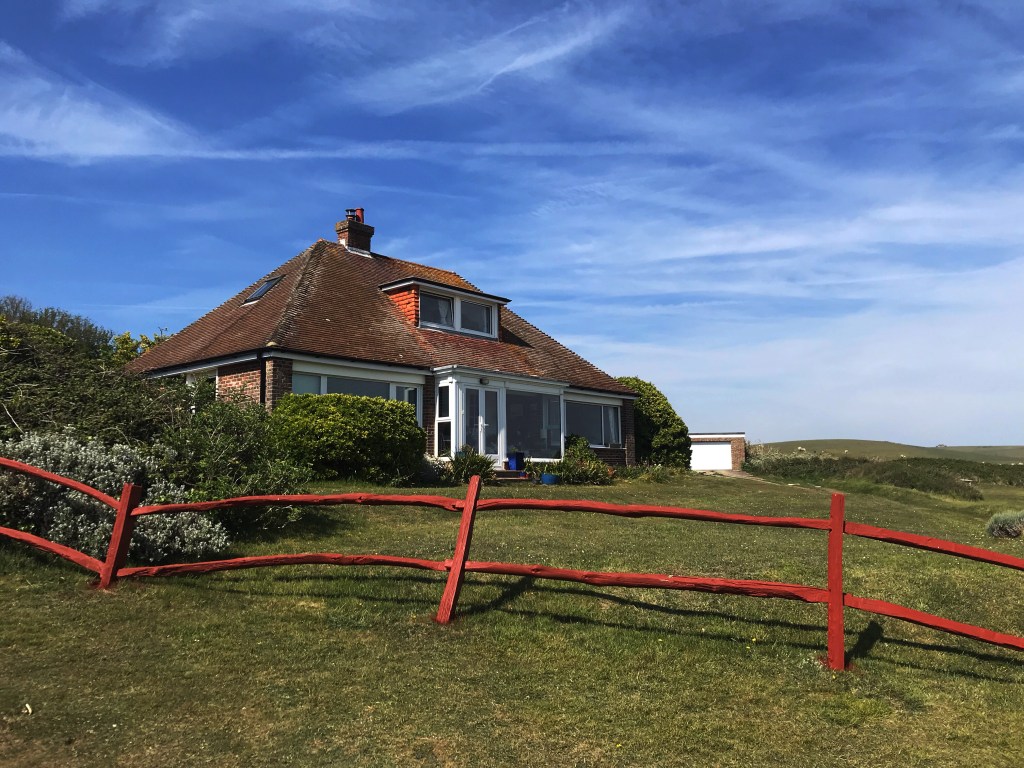
I saw a couple of houses throughout the hike. They were houses next to the ocean, but, to me, they also represented an image of the possibilities of my life. There is the life that is planned for me, and then there is the life that I idealize. I think, realistically, I am not going to have an ocean view for some time. I will, realistically, end up in New York working for a company whose goals vaguely align with mine and live in Brooklyn. There is the life that I envision for myself, and then there is the life that I see for myself. I realized that this is what Sasha Sloan had been singing about in “This Town”:

I want an ocean view, somewhere

As long as I’m next to you, I don’t care

I also want an ocean view. I want to live next to the ocean with someone I love. I want the permanence of sharing experience, ideally next to an ocean. When I see these houses, I forget about my professional and personal ambitions. I no longer want to succeed in whatever field I choose or make a the largest positive contribution to the world that I can. It’s not important to me anymore. There is the world that I want to create, but then there is also my world that I want to create. I realize what I truly value in life. I want to love. I want an ocean view. I want to grow old with someone I love in a house with an ocean view.
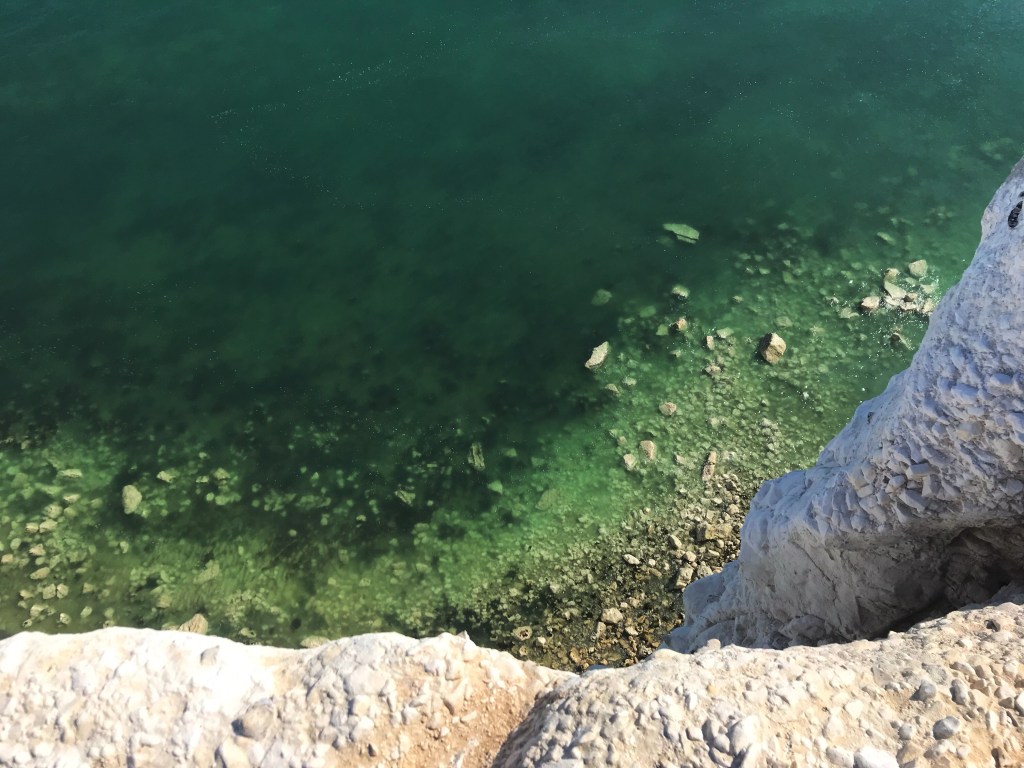
There weren’t any bathrooms throughout the trail, not surprisingly. I had just finished the Game of Thrones series finale, and I have always wanted to taste what Tyrion meant by pissing off the end of the world. Although it was a nice day, there were very few people around, especially in the mid-region between Seaford and Eastborne. It seemed as if people would just turn around right before they reach the midway point of the Seven Sisters. Especially because I had been staying hydrated, I really needed to pee around the around the Beachy Head. So, I stood on the edge of the cliff and peed into the ocean.

I don’t think the ocean minded. It was already greenish-blue.
There was one point when I walked on a rocks next to the beach. I noticed that the larger the rock, the higher the frequency my step produced. For some reason, I found my realization to be intently curious. I stepped on stones throughout the beach in an attempt to pinpoint an optimal stepping pattern to create a sound that is acoustically pleasing, if, of course, aesthetics could also be transformed into acoustics with the same theories surrounding them. I did not want stop stepping on stones or throwing stones at other stones, but the optimal pace had already confined me to walk at a certain rate.

I also came a realization that I had no idea which way the wind was blowing. Despite turning my hands in multiple directions, I had almost no idea. It just seemed so arbitrary. The wind did not care which direction I had turned my hand. It has no incentives to reveal its true direction to me. Although I can attempt to sift through the evidence, in the end, it seems almost futile because the wind can change direction as it wills, and I am helpless but to accept the direction that the wind has presented to me in its windy temperament. I would tell the wind to piss off, but the wind is still there all the same.

My day ended with me sitting at the Belgian Cafe. I was craving fish and chips, and I had originally planned to go to a fish and chips take out place that got 4.5 stars on Google Maps, but I saw a deal right outside this store, and I couldn’t resist. This is what capitalism does to me. But, I suppose I can’t really complain. I did not want to walk anymore. I had spent the entire day walking, and it seems that this last mile to a Tesco and then to a take-out place had been too much for me. The meal at the Belgian cafe, nevertheless, was satisfying. But, as for meals after a six-hour hike goes, I think there is very little that would disappoint me.

After the half pint that came with the fish and chips, I ordered a pale ale to accompany me as I watch the shade creeping into the air. Throughout most of the day, I had taken my waterproof jacket off because it had been too hot. But, now I have the jacket back on, and it is still very cold. My fingers, in particular, were very cold. I drinking a pint of pale ale to be the last drink that I have in the UK to be quite poetic. Merely a couple of months ago, the very first drink someone had bought for me in a pub had been a pale ale. Now, it is my pale ale that finishes this semester.

Fish and chips are really starting to grow on me. It is too bad that I am leaving tomorrow with no possibility of getting fish and chips again for the near future. It seems that the moment I enjoy something is the moment it taken away from me. What an apt description of life.
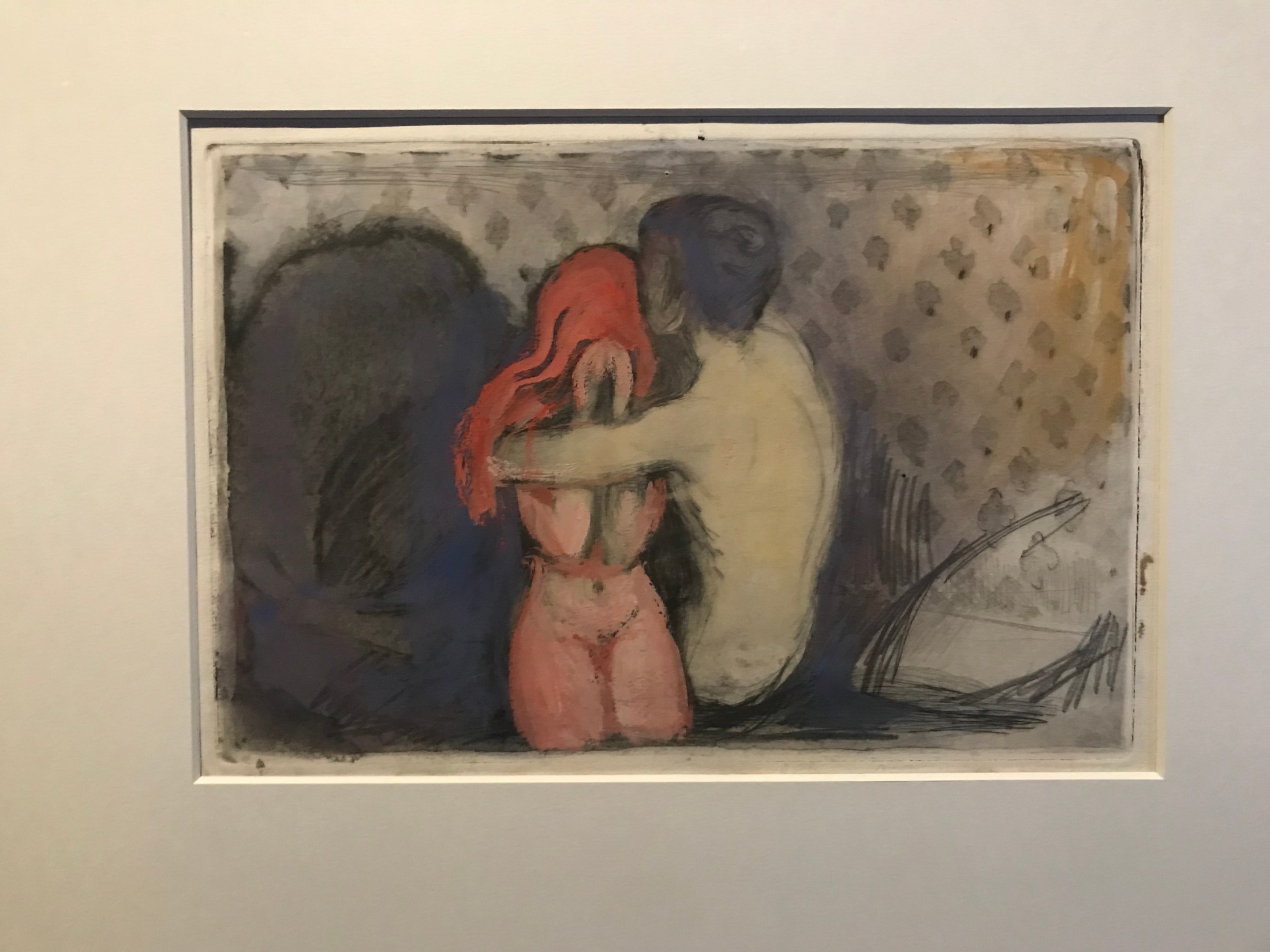
love and angst @ the british museum

I have been looking forwards to this exhibit featuring Edvard Munch for some time. This is, after all, the subject of the independent study that I have done for some time now. Even when I had visited the British Museum earlier in January, all I wanted was to see “Love and Angst” when it became available to the public in April. But, as April came around, I didn’t realize how much time my essays would take. I have read about Edvard Munch briefly before I came to the exhibit. Namely, I bought a book titled, Edvard Munch. Despite the delay, I was ready to see this exhibit, and ot would seem fitting that this exhibit is the last destination I made in the UK before I took the Piccadilly line from Holborn to Heathrow.

Perhaps my favorite drawing in this exhibit is one of the first ones I saw, titled The Kiss. It is a drawing of a boy and girl kissing in front of a window. The faces are blurred together. Their arms are wrapped around each other. Neither of them are aware that they are being observed. But, the part that appealed to me is the anonymity. To a certain extent, it reminds me of some moments in my past relationships. Kissing, while naked, in front of a window is a moment that has defined my understanding of love in college. It symbolizes the fearlessness and intensity that has defined some of my formative sexual experiences.

So intense is the feeling of sexual love that it disassociates identity and merges two separate consciousness. The faces blur with each other because love, in many ways, is a reduction of the sense of self. The face, which symbolizes a medium to communicate self, is reduced nonexistent. Especially in as intense of a moment as sex with someone you genuinely love, it is impossible to turn your attention to anything other than the act itself. Sex with someone you love consumes attention, surrenders identity, and renounces control over your own life. It is one of the few moments in life where you are acting without consideration for yourself.

Another lithograph that I thought was intriguing was Vampire II, depicted as a red-haired girl draping her hair over a sniveling man. The red hair, supposedly, symbolizes the possessive nature of love. Edvard Munch had feared being possessed by his lovers in early in his career. The plaque reads the hair were in the image of snakes, but I imagined them to look like roots or seaweed more than snakes. Similar to a strangling root growing around a tree, the hair does not attempt to assert motion as an animal does. It is alive, of course, but similar to a plant, it can only wait to grow in accordance to the laws of nature. It can not move on its own.

The man is in a state of weakness. I have feared of being possessed in the past, as most people do, but I do not think I have ever been in such a state of weakness where a parasitic plant is able to grow around me as the red hair does to this man. It symbolizes that sadness, or whatever the man is feeling in this print, is a state that requires comfort, but it is also a state of vulnerability. And, within the inevitable desires in love to possess others but not be possessed ourselves, it is the moments of sadness that define our resilience to love without this desire to possess others or this fear to be possessed. The man should fear the parasitic hair.

I also found his portrayal of Madonna to be quite intriguing. It is simultaneously a saddening and frightening. This, of course, is an especially dark rendition (in terms of the color, but also the mood), but it also strangely intimate. Her eyes. Her eyes are scary but also somber. I kept on staring at her eyes. For some reason, I kept on returning to her eyes. If eyes were considered to be the windows to the soul, perhaps Madonna’s eyes represent the simultaneous existence of insanity and intimacy within the soul. They exist together, as one cannot be perceived while perceiving the other, but they also cannot as separate sentiments either.

After I finished the exhibit, I walked back to the beginning to take one last look at The Kiss before exiting the building. It was one of those few times that I genuinely felt justified in purchasing a ticket to see art. I approach life with the same light as I had before, but with subtle grain of inspiration lodged within the artistic portions of my soul. I suppose it could all be a feeling that fades. Perhaps, Edvard Munch could articulate my ideas better than I ever could with a medium that is just inherently more perfect. Regardless, it was a moment hypocritical to some lifestyles that I represent. But, some hypocrisies seem more just than others.

I took a few more minutes to walk around Covent Garden before returning to Hoborn station to await my train to the airport.

meals with feels – london

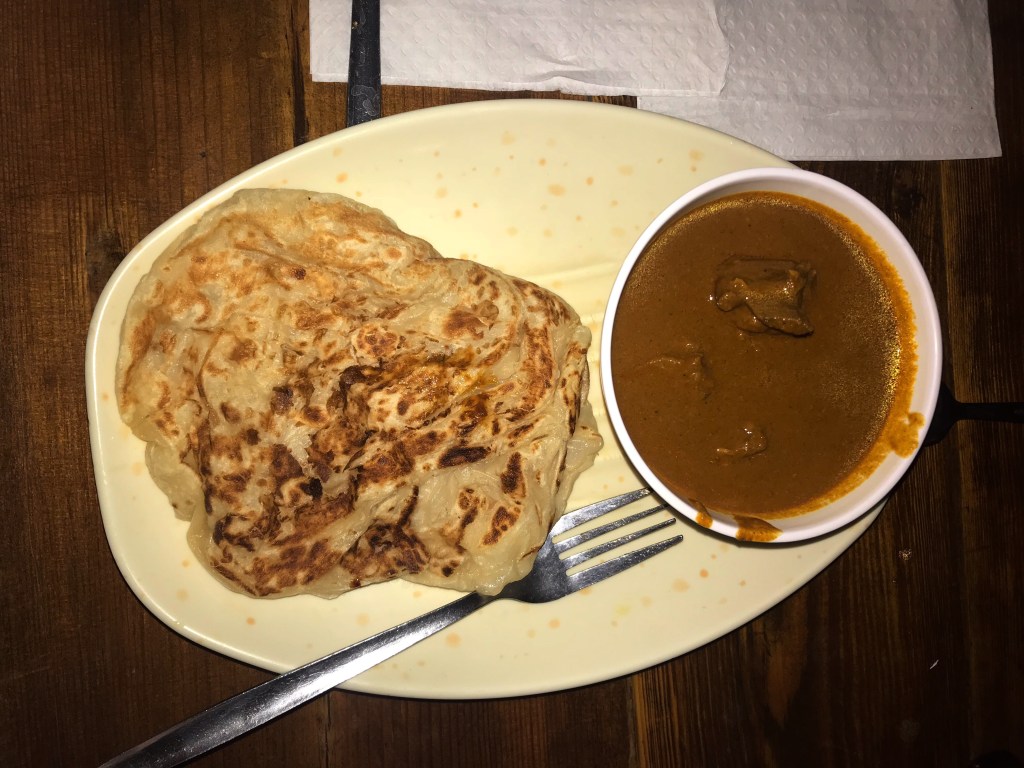
Lamb Roti @ Roti King

Roti King. A Malaysian place. Very affordable. Very good.

This was one of the first places that I had visited in London. According to my friend, it was simultaneously listed on a London’s Best Food list and a London’s Best Cheap Eats lists. So, from its presence on both of these lists, the reasoning goes that the food must be good.

It was. The wait had been roughly 15 minutes. It was a small and shop down the stairs of a street adjacent to a major street. I later discovered that the wait is at least 15 minutes regardless of when I arrive at the entrance. When I finally caught a glimpse of the inside, I see that the structure of the restaurant is a series of wooden tables and benches spread out throughout the entire store. Every table was filled, each with numerous families and friends sitting next to each other without knowing each other. The waiting staff bustled around, furiously distributing the roti that were being made near the entrance.

I am glad that my friend had dragged me here. The first time that I had gone, I ordered the lamb roti. I was cheaper than many of the foods that I have seen, but I was sick and I couldn’t smell the dish very well. I didn’t want to waste a good dish to a sick state. From the little flavor that I could derive from it, I immediately knew that I stumbled into a world of wonders. Even from the mere textures, the roti had a dreamy quality to it where the crispy exterior crunched with each bite, leaving the lamb sauce to fill in the gaps. After a few chews, the soft interior consecrates the remaining substance as the textures meld together.

At the time, the roti I hate was just a roti. But, on reflection, the first time that I had gone to Roti King marked a very distinct period in my life. It was a time when all I wanted to talk about was love and existentialism, but there were so few people to talk about love and existentialism with. As a result, it was a time in my life when I did not believe in the value of conversation anymore. There seemed, to me, to be so little point in conversing at all. It was a time that I felt profoundly alienated from the world, especially from my friends, who I felt were no longer relatable with me. But, as one does, I got over myself.

After my first time, I had gone to Roti King a couple more times throughout the semester. The final time I had gone to Roti King was during my reading period. I had already finished the three essays I needed to write for my English classes, and I was just grinding away for my Issues in Economic Development final. It was a time when I had been waking up at 8 AM and sleeping at 12 AM, filling the time between with an hour commute and studying from 10 AM to 10 PM. Every day for 18 days. It was a feeling that, if I was being very honest, I missed. I had not studied that hard throughout the entire semester, and I missed the sensation of reducing myself to just studying.

I was not talking to many people during that period, but it was a period that felt very true to me. It was, by no means, my preferred natural state. But, it was a state when my internal reflections on myself mirrored the physical manifestation of my lifestyle. I felt like shit, but I wanted to feel like shit. I wanted to feel like shit my entire semester, but there are so little opportunities where I could actively force myself to feel like shit. Becoming a memorization robot is one of those ways. In the lonely semester that it was, it was a sensation I enjoyed. Roti King, that time, was merely a proxy of storing those memories in another delicious egg roti.

In terms of capturing my growth as a person throughout the semester, I could think of no better a place than Roti King. The quality of the food remains the same regardless. The vegetables and the sauce that comes with the vegetables remain as good as ever, and there will always be that one man in the entrance throwing around roti behind the booth. But, regardless of the consistency that is the roti factory of Roti King, it seems that every time I enter, I change slightly more into the person that I have become now. Roti King remains constant, but it captures my evolution as an individual in (mostly) getting over myself.

Sunday Roast @ Blacklock

It was preceded by a trip to St. Paul’s Cathedral. It is a big cathedral, and there is very little that I dislike more than material excess in the name of religion. I remember when the tithe bag was passed around, I found the idea of giving to an organization that has historically had such excess while so many had so little to be quite repulsive. But, it is also one of those moments that made me realize, who am I to judge?

It was also preceded by a trip to street wear shop. It was there that I discovered a contradictory aspect of my personality: that I simultaneously like the aesthetic of street wear but also hate the aesthetic of street wear. Wearing a cosmic-themed puffer jacket that was twice the size of any other jacket that I had ever owned, I realized that I quite liked the flashiness of it. I checked the price tag. Then, I realized that I no longer liked the flashiness of it. But, at long last, I finally was able to justify wearing a fake Supreme lanyard to myself.

This was during our wait for Blacklock, which supposed to be one of the best Sunday roasts in London, according to a list, at least. The place had been booked for the next month on Sundays, but my friend and I decided to shoot in the dark and asked to be placed on the waiting list for the day.

About an hour later, as we were window shopping in the alley next to the restaurant, the text arrived. We landed a spot for an hour. Making our way back to the restaurant, the air seemed to giddy with us. I used to laugh a lot at this one summer camp I had gone to in the past, and someone had described me as having inhaled laughing gas. It was an emotion that I haven’t felt in a long time, but I felt it again momentarily. I showed my giddy-ness to the host when he seated us. I showed my giddy-ness to the waiter when he came by to take our order.

We ordered a platter filled with everything. Two Yorkshire puddings. Two pieces of lamb. Two pieces of pork. Two pieces of beef. Potatoes. Tenderstem broccoli. Assorted sauces.

Yorkshire pudding is not like vanilla pudding. Yorkshire pudding is literally bread. It is bread to be eaten with the meat. Meat, which is supposed to be eaten with the sauces. Sauces, which each had a specific pairing. The mint would go with the lamb. The apple sauce would go with the pork. The horseradish would go with the beef. The potatoes were potatoes.

I followed the rules at first, eating my meats with their corresponding sauces, as the waiter had instructed me to do. The flavors complemented each other beautifully. The sweetness of the apple sauce added a much needed change in palette to the savory and rough slice of pork. The mint seemed to light up the existing flavors of the lamb in a way that reminded me of turning up the vibrancy of a photo while editing in post. The horseradish added a kick to a hunk of beef at the moment of contact and quietly dissipates along with my saliva digesting the beef in my mouth. Perfectly paced.

Then, I decided to be edgy and break the rules. I paired the beef with the apple sauce and the lamb with the horseradish and the pork with the mint. I mixed and matched and added the sauces on top of each other. It tasted just as good, but not necessarily better. Apple sauce does not seem to go well with any other meat; the texture just seems irreconcilable. It definitely was not worse, though. But, perhaps it is I that cannot taste the superiority of pairing lamb with mint and nothing else. Since the Sunday roast is such an established dish, it probably has gone through generations of evolution to reach the perfect pairing. Who am I to question generations of evolution?

This was the first of many Sunday roasts that have solidified many memories in London. Between my friends, my family, and my food.

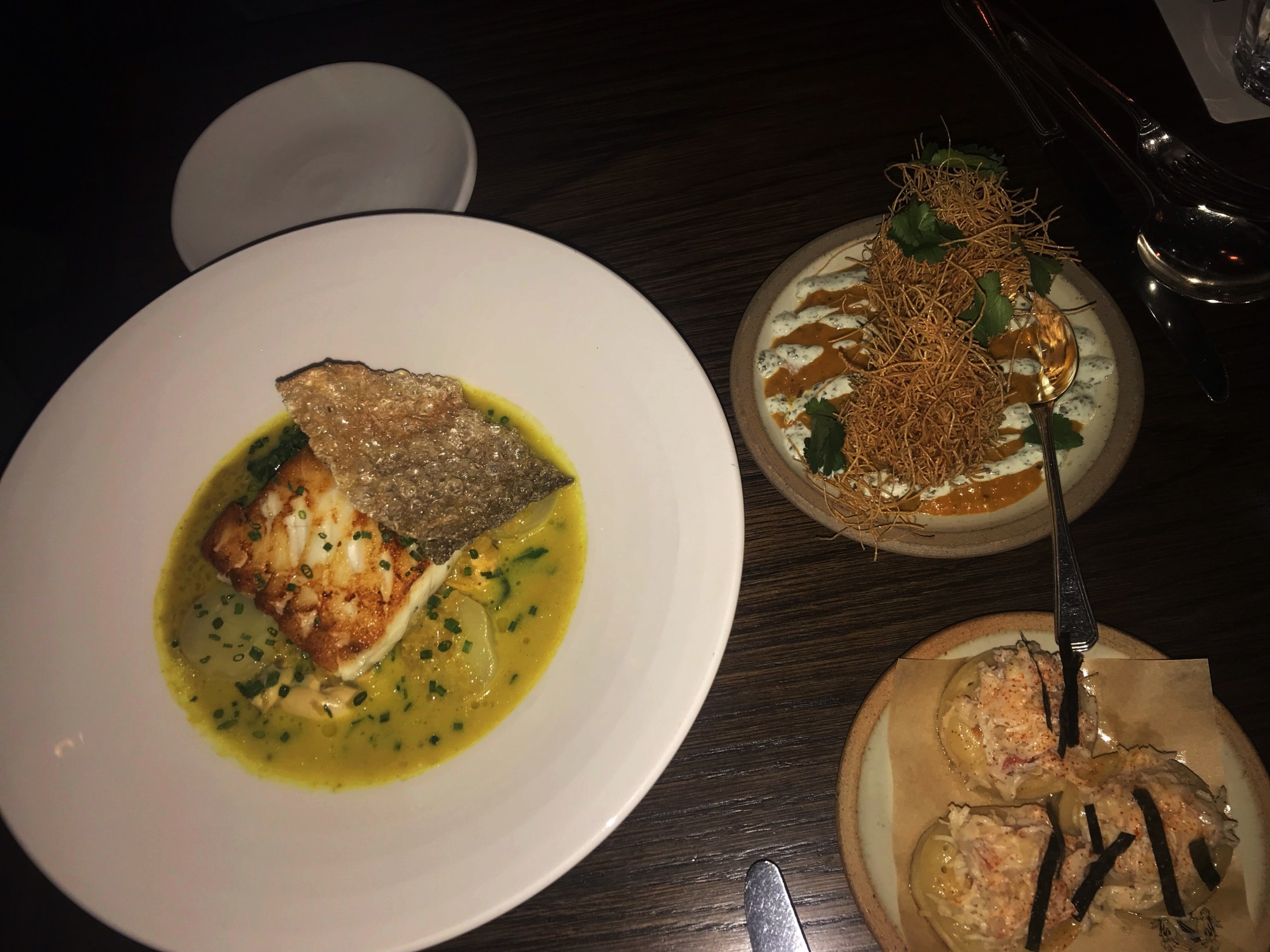
Scotch Egg @ The Wigmore

This was one of the more expensive restaurants that I had gone to. To be honest, I don’t remember much about the food. I had ordered a scotch egg, a cod, and crumpets to share with a friend. The scotch egg, which is on the upper right, had burned my tongue, and I was unable to taste the food for the remainder of the evening. But I do remember the vibe.

It was a vibe I did not like. It was a business casual vibe. I do not like business casual, the concept. I especially do not like the vibe of young professionals in business casual going to happy hour. It makes me feel sick, even more than I had been already. Here was I, in a white hoodie and black jeans outfit that I have worn every day for the past month without washing, next to a sea of young professionals sharing a bottle of expensive wine. I did not fit. I did not want to fit. I felt comfortable in my outfit. I would never feel comfortable in business casual.

The walls were red. Because the entire room was illuminated by a couples of faux-candles, the red of the walls gave an ominous vibe. During the day, perhaps the red would be bright and cheerful in the presence of natural light. But, in the dark, I could not help but to be reminded of the color of blood. Similar to the wall, blood is also a shade of dark red that is only bright in the presence of light. Someone had smeared the wall in a even coat of blood, leaving us to wallow in the darkness of the room.

A couple of lamps on the tables supplemented the lack of light. The placement of the lights allowed faces to be lit from the bottom. It reminded me of the days during summer camp, when some older kids would scare the little kids by illuminating the bottoms of their faces with their phone cameras. There was chatter going on all around me, but I could almost imagine that an absence of conversation. Similar to Edward Hopper’s Nighthawks, it almost seemed that I was experience a moment that was not continuous. The conversation was there, but there was no conversation.

I could not emphasize enough that the only people who were in the pub were young professionals and old men. It would not surprise me if I had accidentally stumbled into the headquarters of some secret society with a reputation for being needlessly frightening. I could not think of a better metaphor. Pretentious, eerie, dreary — the Wigmore is nothing but a painting of a diner masked as a secret society of vampires.

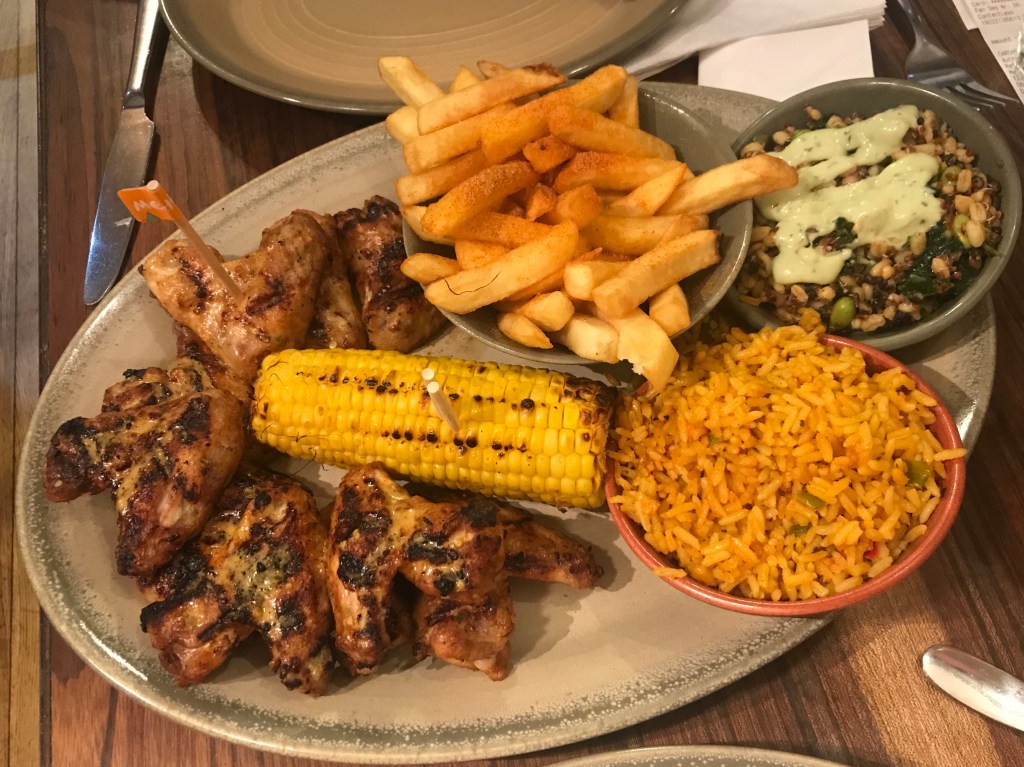
Peri-Peri Chicken @ Nando’s

I went into Nando’s after a failed attempt to find pies. A middle-aged man in a suit ushered my friend and I in, asking us if we have ever been to a Nando’s before. I replied, “No.” My friend replied, “Yes.”

We ordered a chicken wing platter for two, composed of ten PERi-PERi chicken wings and four side. I have very little understanding of why the grilled chicken is called ‘PERi-PERi’, other than what I have found online about its Portuguese Mozambique origins that have been translated into an integral part of British culture through spicy sauce served on the side. But, because Nando’s started in South Africa, I am defaulting on my opinions.

I was impressed with the chicken itself. The charred bits of the meat added a much needed hint of bitterness to an otherwise juicy interior. Dipping my chicken into the Peri-Peri sauce, I found the acidic blend of lemon and herbs to be a perfect complement to my bites of chicken and chips. While the chicken already had its own flavor locked in its juices, the lemon and herbs accented those flavors in a way that overwhelms my taste buds. I have seen much of the same taste at more expensive restaurants. Yet, despite Nando’s superior taste, I found the overall vibe of the restaurant to be unpretentious, much resembling a fancy fast-food chain.

A lady beside me loudly complained to the waitress about her food, asking to speak with two other staff members and the manager before sending back her food, half-eaten, which would seem to indicate that she found the food to be edible. She had repeatedly used one adjective to describe the food: disgusting. I did not think much of it at the time, as it seems quite an ordinary occurrence. But, after I finished my meal, I asked the waitress what was the cause of her distress, and she told me that the woman thought her food was cold. Neat. Cold food, the worse.

Traditional English Breakfast @ Manis

It’s quite similar to an American breakfast. I don’t even remember what an American breakfast is anymore. It has pancakes right?

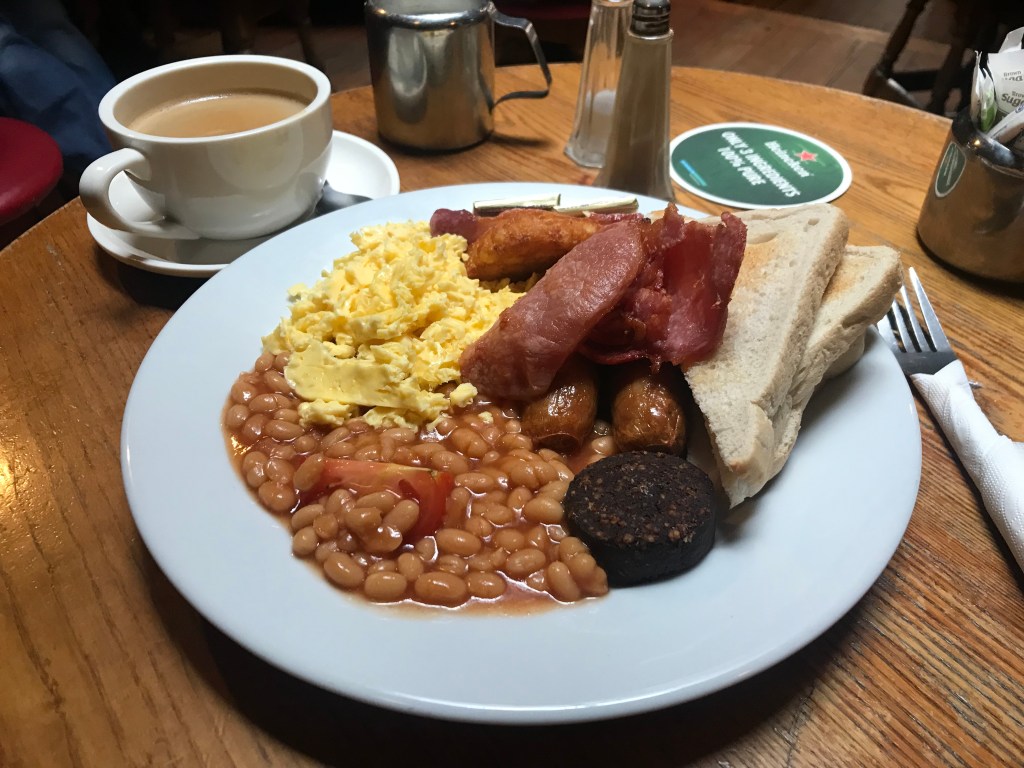
For my last breakfast (and also last meal) in the UK, I ordered a traditional English breakfast with an Americano with no milk. To me, it did not make sense to add milk, which provides so much body to the coffee, when I already had two sausages, two pork rashers, two scrambled eggs, two hash browns, mushrooms, and beans. Otherwise, the acidity of the coffee would not be able to cut through all of the fats that I am consuming. The milk would have added an additional 10 pence to my order, but the 10 pence was not my motivation for not getting the milk. I just think it wouldn’t have tasted as good.

I was sitting with all of my luggage in an alley in West Hampstead. It was nearing the month of June by this point, and the air had been a comfortable 61 degrees with a cool breeze. There were a couple of dogs on leashes here or there, and the cars on small street nearby could be heard. As per usual, there was an overcast.

I have had an English breakfast numerous times throughout the semester. It is one of those things that is actually sold in a lot of places. My first English breakfast occurred after class at a cafe near the School of Life shop, where I discovered the willingness of some individuals to pay for self-help books to address a perceived lack of satisfaction in their relationships. But, in terms of English breakfasts, I have no idea if anyone other than me actually eats them. It could be very well that only tourists eat them, and I am within a handful of people in the entirety of the UK that actually eats English breakfasts.

The sausage had a crisp exterior and a warm savory interior. The bacon was a bit too salty and unsatisfyingly dry, but it was within expectations. Each time I would take a bite out of the sausage or bacon, I would follow it up with a bite of hash brown and a gulp of coffee. The hash brown would mitigate the salt in the meats, and the coffee would annul the overwhelming oils in meat and hash brown combination. Although the egg was sunny-side up, the interior had been evenly and well-cooked. I would add some beans and mushrooms into my mouth to change up the texture whenever the others became monotonous.

For awhile, I have been feeling quite indifferent to my environment. I still feel that indifference to a great extent. But, at my last English breakfast, I felt something. I think.

sofar london

To say that Sofar London defined my semester would be quite an accurate statement.

a compilation of sofar london

There were very few things this semester that had brought me some semblance of happiness. Even fewer that had brought me some personal fulfilment. But, despite the chaos that I have navigated, it is Sofar London that allowed me to feel vaguely as if I wasn’t in a territory that was an entire ocean across from home.

It is interesting. I have never felt homesick until this semester. Mainly, I craved the food that my parents had made. The Chinese food in London, if I am being very honest, was very disappointing. Or, at least, it was quite unlike all of the Chinese food that I have been used to having throughout my entire life. Because I could not find the comfort of Chinese food, and for other reasons I suppose, I became quite lonely. The world seemed unfamiliar, and I became acquainted with the unfamiliarity of the world. Similar to Samuel Beckett navigating the confusion that is late modernism, I approached the world within the theatre of the absurd.

I found some sort of community within Sofar London. I say some because Sofar London is quite a large organization. With over around 80 concerts per month, their volunteer community was immense. But, immensity also has its problems. In Philadelphia, there were only around 10 concerts per month. I was acquainted with almost all of the volunteers in their stories, and I memorized most of their names, which is something that I find oddly difficult. But, here in London, I only knew a couple of volunteers by their names. Despite all of the shows that I have volunteered at this semester, I only know a handful by their names.

For a time, I lost faith in dialogue as a concept. I was in a phase in my love where the only thing I wanted to talk about was love and existentialism, and it seemed that no one around me wanted to talk about love and existentialism. I found all other topics of conversation to be unfulfilling. I was also disillusioned with the fact that none of the conversations that I have had led to anything. Given the nature of adult interactions, it just seemed to me that making friends as an adult is significantly harder than it is as a student. Most of my friends comes from forced proximity with each other. After all, it is quite difficult to ignore people that you see on a regular basis. But, within my interactions with adults, all conversations seems to be a product of obligation that I did not know how to create.

Sofar London changed a bit of that. I still want to talk about love and existentialism, but I have accepted that the majority of people in the world do not general gravitate towards love and existentialism as their go-to conversation topic. I have also accepted that the vast majority of my conversations will not lead to anything. The vast majority of conversations in my life are conversations that are not meant to continue. They come and go, and then we continue to live on with our lives marginally changed from before. That is the way of the world, and I have learned to fight it no longer. Just because I have made friends in the past does not mean that I will make friends in the future. I have come to accept that, in the social sphere, the world is indifferent to me.

But, it would seem that there’s also some degree of beauty that is associated with the one-time conversation. A conversation comes, and a conversation goes. Regardless of how the conversation goes, it is, by nature, going to end. The understanding of this impermanence has allowed me to take some more risks in conversation. I have learned how to better transition into a conversation into a discussion about love and existence slightly, yet there will always be limitations to my abilities because I am not someone who is good at holding conversation. For those who are unreceptive, I transition into a topic I do not care about. For those who are receptive, I engage the topic with as open ears as I could muster. Regardless, the conversation ends, and only I can derive meaning from it when it is not given to me.

There is also, of course, the musical aspect of Sofar Sounds. I was able to interact with more artists than I could count. As the emcee of each concert, it made it quite easy to strike up a conversation. After all, I had legitimacy to talk to them. There were questions that I had to answer of course (i.e. hometown, latest release, upcoming concerts), but then there are also the questions in which I ask because I am genuinely curious. Most, if not all, of the artists I have talked to are receptive to talk about themselves. Most individuals are receptive to talking about themselves, of course, but there is a special sort of pleasure that is derived, it would seem, from artists talking about their art. Such conversations captivated me.

Sofar Sounds is an organization that attempts to empower all musical genres. As a result, I have heard more musical genres than I have previously thought to be possible. And, as someone who wants to create music one day myself, I truly found all of the acts I have seen to be inspirational. I do not have a a voice yet, but it is these artists who made me want a voice. I want to say something that is worth saying, and I want to express it through a musical medium that is true to me. There is a certain authenticity that seems to exist in the presence of artists and their craft, especially unsigned artists, and there is very little in the musical world that brings me more pleasure than to hear the truth that is created in the name of music.

There is the song that is sung, but then there is also the story that goes behind the song. I remember, on a very special instance, when I had the opportunity to have a conversation with a musican that streched over two hours about her understanding of love. After the concert, we had hit up a nearby pub at the suggestion of one of the volunteers. Over drinks, I asked her a question. That question gave birth to an inferno that defined the most enriching conversation that I had had all semester. But, as the nature of conversations at concerts go, I never had a chance to speak with her again. I do not expect to, but I still hold that conversation dear in my memories. It was one moment where I was not living the myth of Sisyphus.

I am writing on the United Airlines plane back to Philadelphia. In a few hours, I will return to Sofar Philly, where it all had started. Without Sofar Philly, I would not have been able to have the countless conversations that I have had this semester. By the end of the semester, I wouldn’t say that I have made friends through Sofar London — I don’t use the word friend lightly — but I definitely would say I have gotten somewhere.It is a position that was doomed from the start.

Sofar Sounds — what a beautiful organization.

meals with feels – dublin

Sheridans Cheesemongers

I was struck by the cool air immediately as  I walked into the store. Cold, windowless, full of cheese decorating the shelves, I felt as if I were walking into a refrigerator. I walked around a bit to admire the cheeses. On the wall, there was a poster detailing which region in France the cheese had come from. I was not familiar with any of them. As I walked halfway through the shop, the server greeted me with a roll of cheese in his hand. I asked him what he sold here. He began listed the cheeses, charcuterie, and wines that were on display.

Then, he walked me into an even colder room in the back where there were about a dozen sandwiches in the making. All that existed at the moment were a couple of slices of bread with some mustard and dills spread on top of them. I told him that I wanted a sandwich, and he set aside one mustard and dill bread and furnished it with some Comté cheese and turkey breast. He added some leaves doused in olive oil and vinegar into the mix.

I asked if he could toast it. He said no.

I took my sandwich outside back into the presence of sun rays. It was warm. My sandwich was not. I don’t recall seeing any small refrigerators in the shop to display the already-made sandwiches. I suppose there is very little reason to refrigerate sandwiches when the entire shop is a refrigerator in itself. The cold sandwich was still in my hand. I looked around to find a suitable place to eat my sandwich. It was early enough in the day where most of the streets were clear, so I immediately zoomed onto a suitable spot.

I ate my sandwich from Cheesemonger on the steps of St. Ann’s Church looking over a business formal attire shop called James Herren. The spot was good; the view was not. But, as for toasting sandwiches, we do not always get what we want in our lives.

I took a bite into my sandwich. It was very bread-y. I took another bite. This time, I could taste some of the mustard. I took another bite. Now, I could taste the turkey and cheese. On my fourth bite, I could taste the entire concoction of meat, cheese, bread, greens, and dressing.

The initial flavors blended together well with a bite. The vinegar complemented the mustard well since the mustard was selected from one of the more fatty varieties. But then, as the parts digest in my saliva, I found the body of the bite to be a bit disappointing. The turkey seemed frozen. The distribution of flavor with the meat seemed off, as it seems that there was a separation between the actual taste and the meat itself. Call it a separation between extension and thought, if you will. The presence of the cheese seemed underwhelming. There was only a thin layer that covered the layer of mustard, and even with a pungent taste such as Comte, mustard and meat easily defined the palette regardless of the cheese. The dill pickles, however, were cute. I really liked the dill pickles.

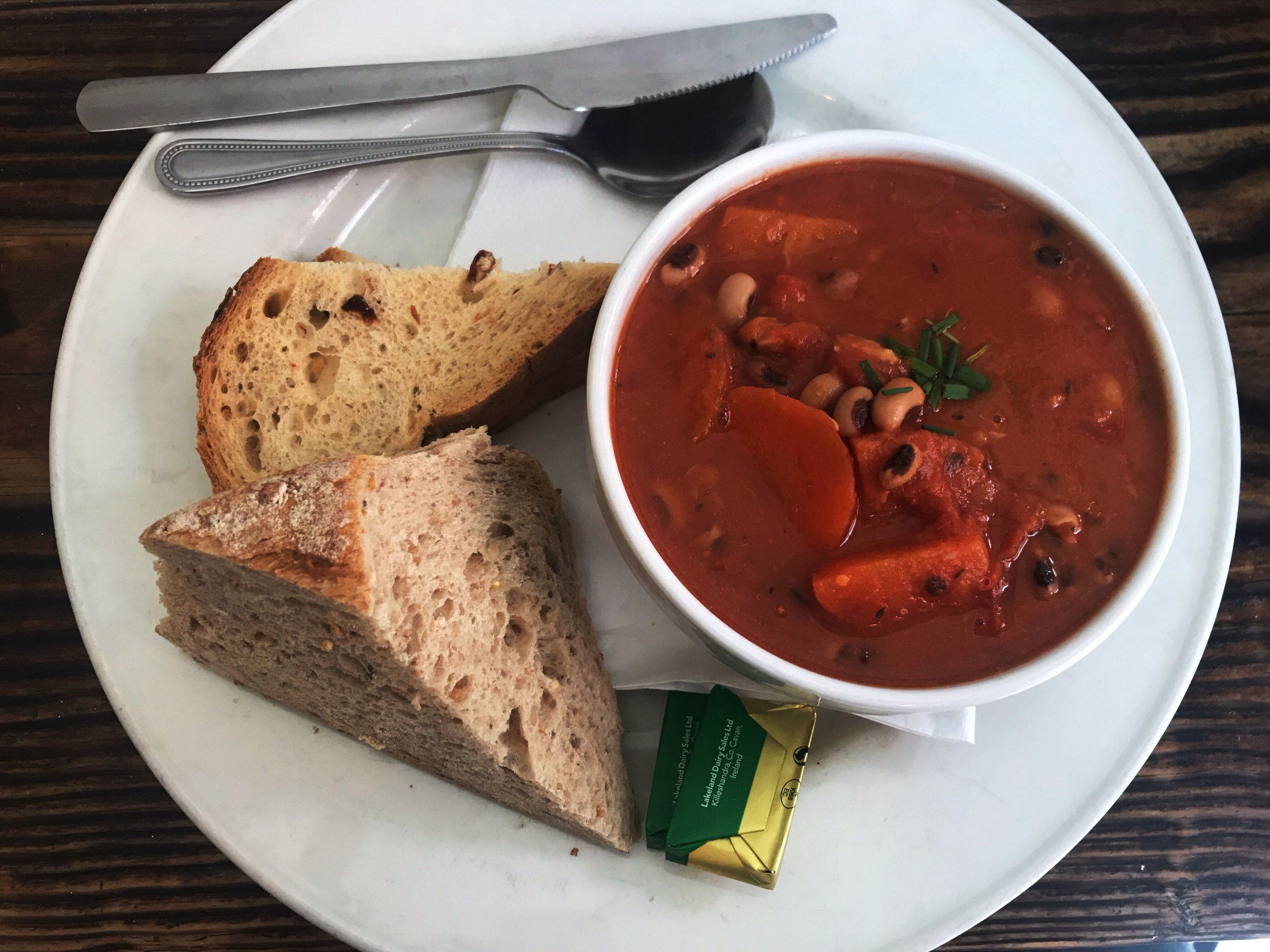
Soup Dragon

Soup Dragon was located next to the River Liffey. It was a quaint little place, and when I arrived, I was the only person in the shop. I had ordered the spicy vegetable gumbo with a tuna melt sandwich from the specials menu. The canned tuna, I found out later, did not pair well with the water-y vegetables. It seemed that neither of the foods were flavored, but I did appreciate the diversity in textures. The carrots were well cooked in the soup, leaving a firm yet soft body that allowed my teeth to easily plunge through. The soda bread that came with the tuna melt was crisp and bodied. With the help of the soup, the mixture gave me a sense of satisfaction each time I swallowed. By the time I finished, I suppose I was satisfied.

A few bites in, a delivery person ordered a soup and sandwich and headed on his way. It did not seem, however, that he was ordering the meal for someone else. There is no reasoning I have for this belief, as it makes more sense that this person ordered the meal in place of someone else, but just from the dynamic between this person and the lady at the counter, I would imagine that he, too, enjoys their food and frequents this place. Alas, I am merely speculating on virtually no tangible information. It seems that a lot of my thoughts is speculating off a no tangible information. But, isn’t that the process of creation?

They were playing Lana Del Rey at one point. That made me happy.

Olivo’s Fish and Chips

I found it deeply humorous that one of the recommended dishes in Dublin was fish and chips. I suppose it made sense, given the similarities between the UK and Ireland. But, at the same time, it’s fish and chips. It reminds of the time I went to Brighton with my friend and searched for attractions there, only to be hit with: fish and chips.

I never quite found the appeal of fish and chips. It is, quite literally, fried fish with some fried potatoes. I assumed that it would be late-night snack to have while drunk, but it seems that individuals consume fish and chips throughout the entire day regardless of their levels of intoxication. But, for some reason, I had a craving for fish and chips. It was, after all, a day filled with walking, so I could very easily be craving the carbs and oils that have been conveniently converted into a dish called fish and chips.

I ordered the fish and chips from Olivo’s Fish and Chips because I assumed Olivo’s Fish and Chips served fish and chips. I assumed that Olivo’s Fish and Chips would sell fish and chips because Olivo’s fish and chips had “Fish and Chips” in its name. I was correct that Olivo’s Fish and Chips sold fish and chips. I also assumed that Olivo’s Fish and Chips would have decent fish and chips because Olivo’s Fish chips, with the same reasoning that Olivo’s Fish and Chips sold fish and chips, also had “Fish and Chips” in its name.

It was a take-out place. The vibe reminded me of the Crown Fried Chicken on 40th and Market because that is also a take-out place. Because I do not frequent takeout places that frequently, most take-out places seem quite similar to me. While I was waiting for my fish and chips, two girls, who couldn’t have been older than 12, walked in and ordered some fish and chips of their own. I received my fish and chips in a brown paper bag. The man at the counter asked me if I wanted salt and vinegar in my fish and chips. Yes i said yes i will yes

Thanks Molly.

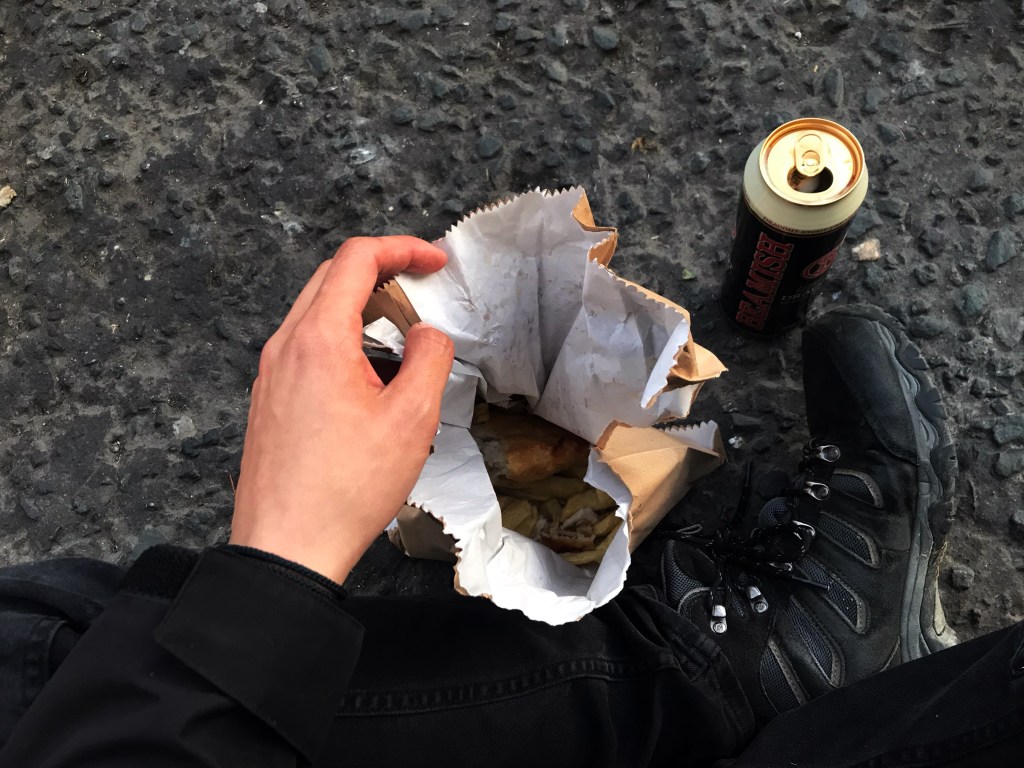
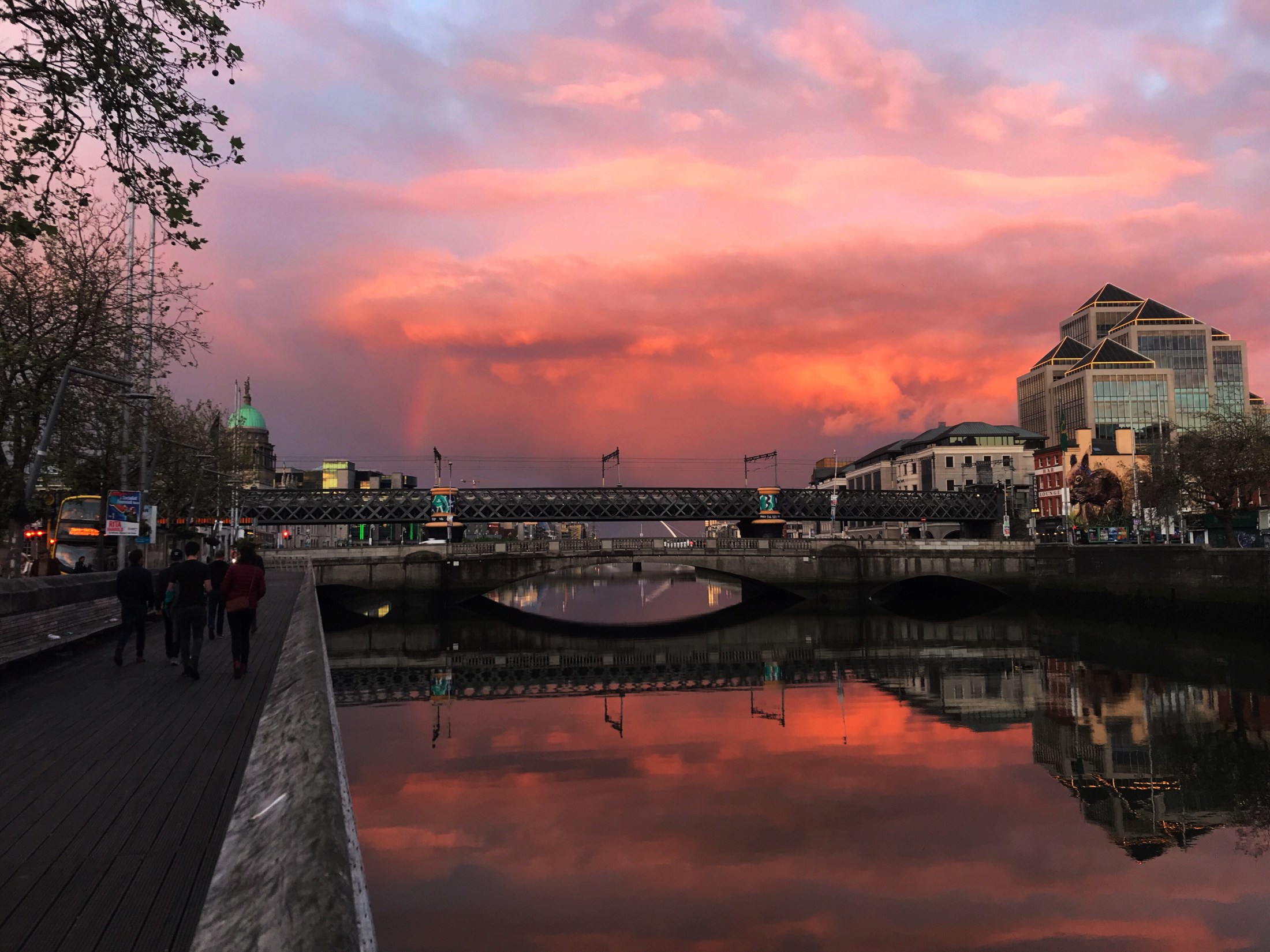
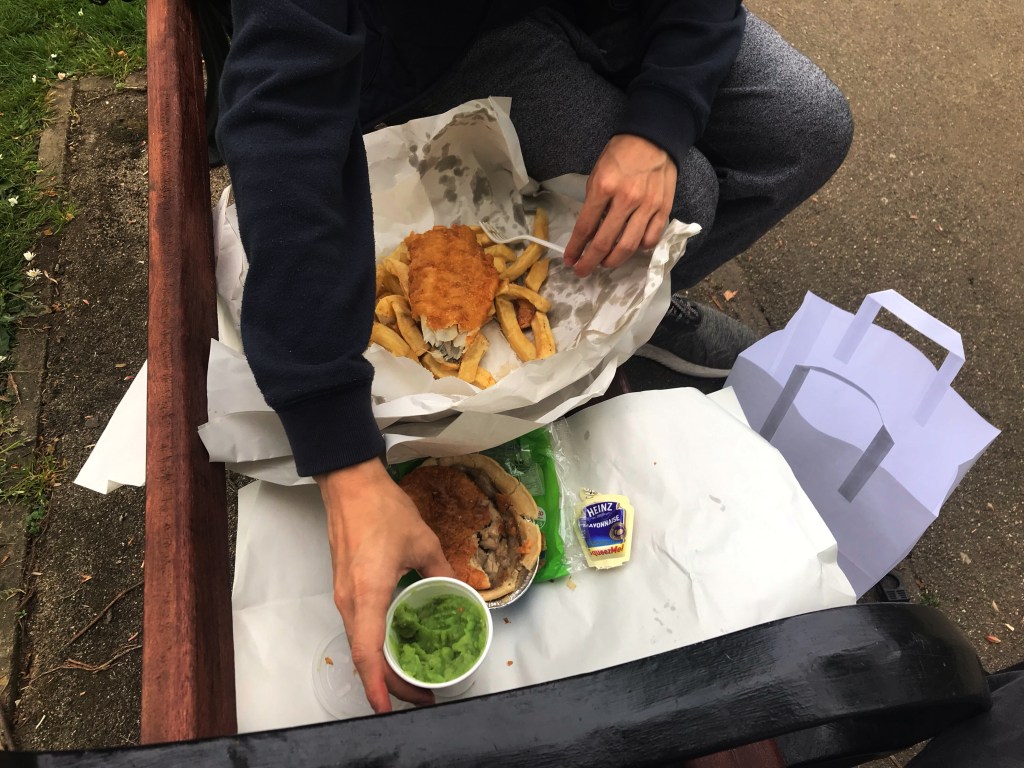
Because Olivo’s fish and chips was a take-out place, I took out my fish and chips to outside of the shop. I sat down on the curb with my plastic fork in one and and my brown paper bag in another hand. The sun was in the process of setting, imbuing the clouds with a delicate shade of pink. I would have loved to pluck some of the cloud off to eat as a cool and moist cotton candy, but unfortunately, that is not how clouds work. But that being said, cotton candy is quite dry and requires more moisture to enjoy to the fullest extent.

I have always been fascinated by the optimal distribution between fish and chip in each bite of fish and chips. There was a lot of chips and only one fillet of fish. How do I distribute my bites? It would seem that I required an uncomfortable surplus of chips in each bite in comparison to the fish. Otherwise, if I did not excessively consume chips with each bite of cod, then I would run into a lot of leftover chips, which would be even worse to finish than a mild addition of chips to my optimal distribution of fish and chips in each bite.

About two bites in, I realized that I was thirsty. I also forgot about how dense fish and chips was in terms of oils and carbs. I walked across the street to Centre, which I assumed was one of the local supermarkets in Dublin, and purchased a can of Beamish. I sat back down on the curb and continued to each my fish and chips. The beer complemented the taste quite wonderfully, as the tepid excess in the oils can be washed down quite efficiently by the beer. But, at that point, I was not consuming as much beer as to finish on time with the fish and chips, so I would have leftover beer in the end.

I finished my fish and chips a couple of moments before the sun had set. I finished my beer afterwards. I realized, only after I had finished, that there was a ping pong ball in my beer can. What a curious moment. Then, I headed to the Cobblestone, which I have read hosted some traditional Irish music every night after 8 PM. I wanted to see a violin in action, and I was determined to go. It has been so long since I have seen a violin.

wandering alone in dublin

Traveling alone… is not that great, in my opinion.

The entire semester, my roommate had been hyping up the prospect of travelling alone, claiming benefits such as being able relax without pressure to compromise on how to spend the day. But, all I could feel throughout my entire three-day trip to Dublin is loneliness. It is a loneliness that I have forgotten about for quite a while, and it was not “relaxing.” Because, there mere act of travelling necessitates an exposure to an unfamiliar environment. That is, of course, one of the many motivations of travelling. But, there are also multiple ways to confront unfamiliarity and discomfort: one is with others, the other is by yourself.

I can always feel the indifference of the universe. But, sometimes, especially when I have been in a singular environment for quite some time, I forget about the indifference just for a little bit. There are aspects of familiarity that cause me to believe, even for one second, that the universe is not a stranger to me. I remember within my first days in London, I was reminded once again that I have only constructed pockets of illusions to address my fears of indifference. People would walk past me, unaware even that I existed. I would see stores such as Sainsbury’s and Curry’s PC World and Waterstones have no memories associated with them.

It was in those moments that I genuinely missed the automatic interactions that I used to have on Locust Walk. Even if I were to ceremoniously make plans to get brunch with someone who I have not spoken to for multiple months, there exists a degree of familiarity to the interaction. I would walk in a street an actually recognize the people around me. I would have the option to converse or engage with a person that would make me isolated from the indifference of the universe, even for a little bit. It was a choice that I had, which I sometimes took because I have social needs.

I was surrounded by familiar objects. From the walk from my house on Filbert Street to my first class in statistical learning in the the Vagelos Building, I would walk past familiar sights. I would walk past the 40th and Market subway stop, where there would be a line outside of Crown Fried Chicken in the evenings when I return from the library. On 40th and Chestnut, I could turn left and ride on the bike lane instead of the sidewalk, where I would be able to cruise downhills without fear of chips in the road. I would know when to turn right when I hit the bottom of the hill on 34th and Chestnut. Then, I would pass by sites such as New College House and Penn Book Center before I arrived at class.

Slowly, the familiarity grew, I ate enough Tesco meal deals to know intuitively which sandwich I wanted to get even before I arrived. I have played enough games of Starcraft II in Curry’s PC World never to want to touch Starcraft II in my life ever again. I have read enough books in Waterstones to memorize the layout of the books on display in the philosophy section on the second floor. Slowly, the unfamiliar because familiar, and I once again constructed an illusion of familiarity to forget about the indifference of the universe.

This, of course, is assisted by routine. But, it is also assisted by the prospect of sharing discovery. I discovered London with people. It is the existence of people that mitigates the feelings of alienation that is associated with the transition into an unfamiliar environment. And now, when I reflect on all of those cities that I have discovered in the past, it is always the existence of a familiar person to mitigate the sense of profound discomfort that is associated with re-discovering the indifference of the universe. Because, while individuals can walk past me without a blink of an eye, it is the person beside me that genuinely cares.

It is nice to know that someone genuinely cares about me in a sea of individuals who couldn’t care less whether I died or became president or whatever. They have their lives, and I have mine. It is the same standard. Given the homogeneity of strangers, there are limitations to how much I can feel and empathize without shared life experiences. Without the familiarity that is associated with sharing existence, there only exists me facing the indifference of the universe alone.

I would walk along the River Liffey. I would see sights that have been pointed out to me in the past. All the way to the west, there is the Guinness brewing factory. I could tell because it says “Guinness” at least two times in this massive hunk of metal. It was recommended on virtually all lists of things to do in Dublin, and Google Maps makes sure to point it out. Then, in the middle, there is the Temple Bar area, where “Circe” in Ulysses took place. Even at night, it is not nearly as lively as I imagined it to be, which is good in some cases, I suppose. I imagined it to be a psychedelic experience. It was not. Then, all the way down in the east, there is the Samuel Beckett bridge, named after… you guessed it, Samuel Beckett. I like his writing.

I could navigate my surroundings because I had Google Maps to help me do it. But, in terms of actually feeling the familiarity in the roots of my intuition, I had none of it. Even as I was approaching the end, when I feel as if I had navigated the entirety of Dublin by foot, I still felt the same insecurity as I had in the beginning. I suppose that is the nature of all forms of travel. Even as I am able to navigate my surroundings without a map, it still seems as if there is a sharp disconnect between the experience of travelling alone and traveling with others and living in a location. I was alone, but I was also lonely.

That feeling defined most of my thoughts on my three-day trip to Dublin. It was me and the city. Of course, there were a surprising amount of American tourists, but these people are not figures of familiarity. If anything, the existence of tourists just like me beside me made me feel even more alienated because these are individuals that I supposedly have some association with, which would supposedly recall a feeling of familiarity. But what I actually felt differed significantly from what I was suppose to feel. I did not feel the camaraderie. These tourists are just as much of strangers to me as the locals of Dublin. But at least they have someone to experience the city with.

This feeling was especially pronounced when I had visited a music pub in Temple Bar. Of course, Temple Bar is a very tourist-y area. But, unlike me and a few old people here and there, everyone came with someone else. Especially the tourists. The tourists all came with someone else. Perhaps it is a friend. Perhaps it is a family member. Regardless, it was only me and my Costco backpack versus the rest of the world. Some people seem to be having fun. I have since learned to take this with a grain of salt, but it genuinely seemed like they were having fun. And, if they did not, then they left discreetly.

But then there’s me.

I have been alone for some time now, but it is only on those moments where I am completely at the mercy of the universe where I feel completely alone. This three-day trip to Dublin was an example of a time that I felt completely helpless in terms of my loneliness. There was no one that I could reach out to to mitigate my feelings. As far as I know, no one that I have even a second-degree connection to was in Dublin with me. There was no one to share experience with; I could only face the experience of unfamiliarity by myself. Just me, myself, and G-Eazy’s lyrics.

Just kidding, I don’t listen to G-Eazy anymore.

below the o’connell statue

I am reading below the Daniel O’Connell statue located on the north side of O’Connell bridge. It is quite an an important statue in James Joyce’s Ulysses; Bloom references it numerous times throughout his narrative arc. It is (although I could be remembering this part incorrectly) the statue in which Bloom peers from behind to ascertain whether the statue has an anus or not. I checked myself, too. The Daniel O’Connell statue does not have an anus.

But, here I am, sitting next to one of the few statues that I have read about in Joyce. I should be feeling a constant excitement for exploration. But, I don’t. I really don’t. I do not feel excited to be in Dublin (or even London for the past five months). It is ungrateful of me, but I have not been excited for anything for a long time. It is just time, and time passes. I suppose memories retain, but even those change and fade over time. Especially for an experiences as short as a weekend trip, I don’t feel like I could gain anything insightful out of this experience; unlike living somewhere for a prolonged time, vacations don’t feel real.

I thought that I deserved to go to Dublin because I had spent a semester studying Joyce’s Ulysses, which, of course, takes place in Dublin. But, being her in Dublin right now, I still do not feel as if I am justified in being here. I am not going to make any friends while I am here. I have not made any friends in my time in London either; all I have are a short list of acquaintances and a endless set of one-time conversations. And, for a time, I thought that those have value, but now I am even questioning the point of those too.

A friend of mine a while back had told me that she did not have any travel plans over winter break. When I asked her why, she simply stated that she feels that she does not have any desire to go to anywhere specific. Without the desire to travel to a specific location, the only desire that remains is the desire to travel for the sake of traveling. It could be for conspicuous consumption, for peer pressure, or for the #clout. But, if the desire does not exist for exploration of somewhere specific, how can we justify to ourselves that we deserve to spend money going somewhere?

This is how I feel right now. I am here in Dublin. I am sitting below the O’Connell statue. I know the basic significance of O’Connell in Ulysses as well as Irish history, but somehow, I still do not feel as if I deserve to go on this post-exam vacation.

It should be proportional. If I were to pursue a PhD in, for example, literary modernism with a concentration on Joyce studies, then I would feel quite justified going to Dublin after spending an entire year dedicated to Joyce’s texts. Bu I am not pursuing a PhD. I have merely spent one class in one semester vaguely understanding Ulysses while the majority of my energy had been spent on…  I don’t even know what. Chess? Recruiting? Being sad?

I went because I was fearful that I would never have the opportunity to go to Dublin again in my life. After all, a flight from London to Dublin is very different from a flight from Philadelphia to Dublin. After taking a class on Ulysses, I felt as if I should go to Dublin because otherwise I would not be able to consecrate some of the research I have done into physical images. But, why would I want to do that at all? Is it because I have been taught that I should? In reflection, my parents have encouraged me to spend money in pursuit of knowledge.

But, here I am, and I don’t really want to. What do I even want anymore? Do I want to return to Philadelphia, where I could pursue my independent studies on the psychoanalytic relationship between love and sadness. Do I want to start my internship in New York, where I am, yet again, exposed to a new environment full of impermanence and novelty? At this point of my life, I have no idea what I want anymore. I have no idea what I value anymore. I have no idea what makes me happy anymore, if I want to be happy at all.

in pursuit of pie

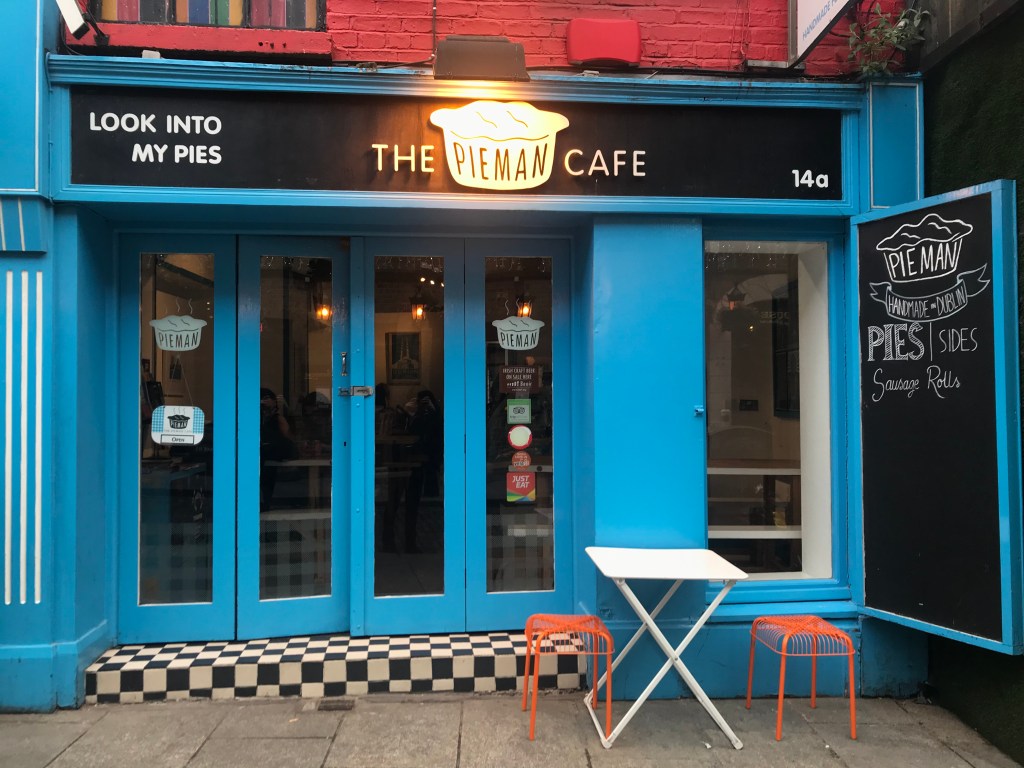
I went to The Pieman Cafe after I had taken a 30 minute nap.

Perhaps it had been the longest day that I have had this semester. I woke up at 3:30 AM in order to make my flight at London Heathrow at 7:00 AM. I drank my first cup of coffee immediately before the flight so I would have a clear head after I took my plane nap. I drank my second cup of coffee after I arrived and had an Irish breakfast at Donaghue’s, which included an interesting black pudding composed of baked blood and herbs.

The rest of the day, which started at 9 AM when I had arrived in the center of Dublin, started with an accidental encounter with the Molly Malone statue. The color of the statue was a brown, except for her titties, which were a bright gold from countless tourists getting steamy with an inanimate hunk of metal. I suppose her titties were pronounced, which I suppose got some people off. But, hey, it’s 2019, and who am I to judge fetishes?

Molly Malone was followed by reading Dubliners by James Joyce at Trinity College, photographing birds at St. Stephen’s Green, going to afternoon services at St. Patrick’s Cathedral, and feeling alone at Dublin Castle. By the time I had finished the attractions I had wanted to go south of the River Leffey, it was raining. It is always raining, but then, it was literally raining. I rushed back and checked in at my hostel, which didn’t take long because Dublin’s central district is quite small in size.

“All Star” by Smash Mouth was playing overhead. There were a couple of album covers decorating a bullitin board. The entire shop smelled subtly of butter, which made sense considering that the majority of the finished pies were on display. There was one group of individuals who were there when I had arrived. From their accents, I am almost sure that they were American, which probably puts the legitimacy of the qualities of the Pieman Cafe on the line, considering there doesn’t seem any locals there. But, nevertheless, I wanted to eat pies, so I stayed.

I want to preface my tasting of the pies at the Pieman Cafe by saying that the pies that I had had a mere two days prior at Piebury Corner in King’s Cross, London was one of the most disappointing experiences I have ever had. I am no pie connoisseur, of course, but I would say if the pie requires a effortful stabbing to break, it is probably too dry. The filling was pasty, which is not a pie filling. There is a reason pie filling isn’t called pie paste. If it were a pie paste, no one would want to eat pies anymore. But, Piebury Corner seemed to be popping when I went, so who am I to say that I don’t like their pies? Maybe’s I’m the weird one here.

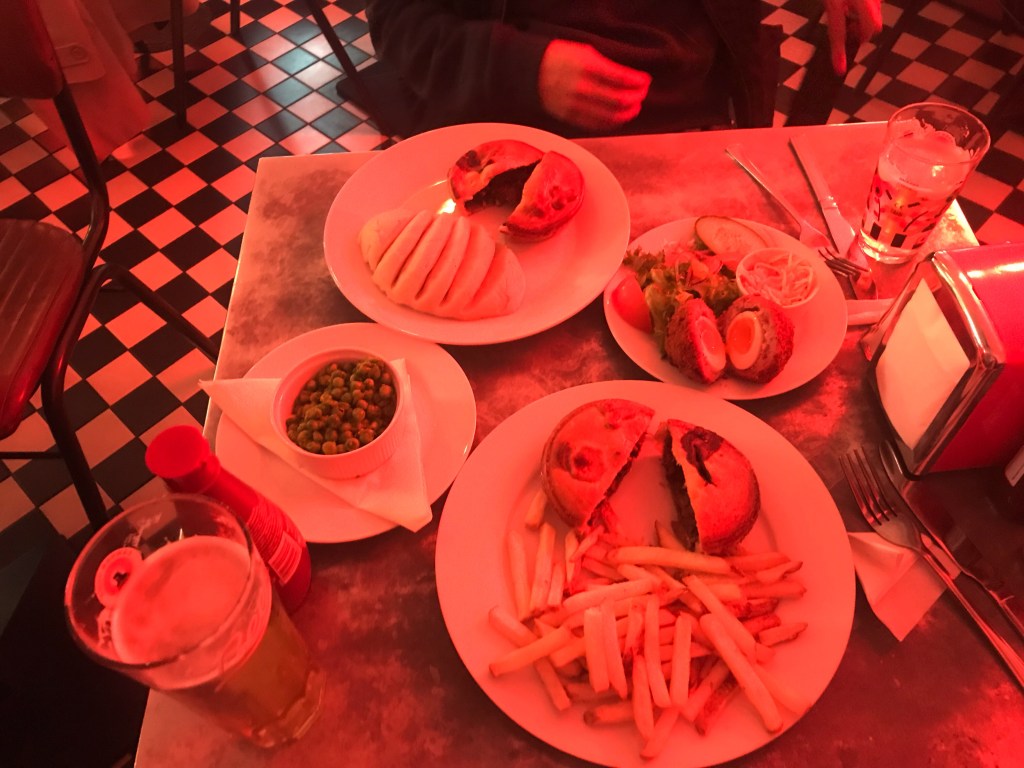
I asked girl at the counter of the Cafewhat the most popular pie in the shop is. She said, “Beef and Guinness.” So, I ordered the beef and Guinness pie. She was also Asian and had a mild accent. I was tempted to ask her where she was from, but I didn’t because I remember how annoying it is when people ask me where I’m from out of the blue. She seemed to be in her mid twenties, and it did not seem like there was anyone else who was helping run the shop. Either way, I was curious, but I didn’t ask.

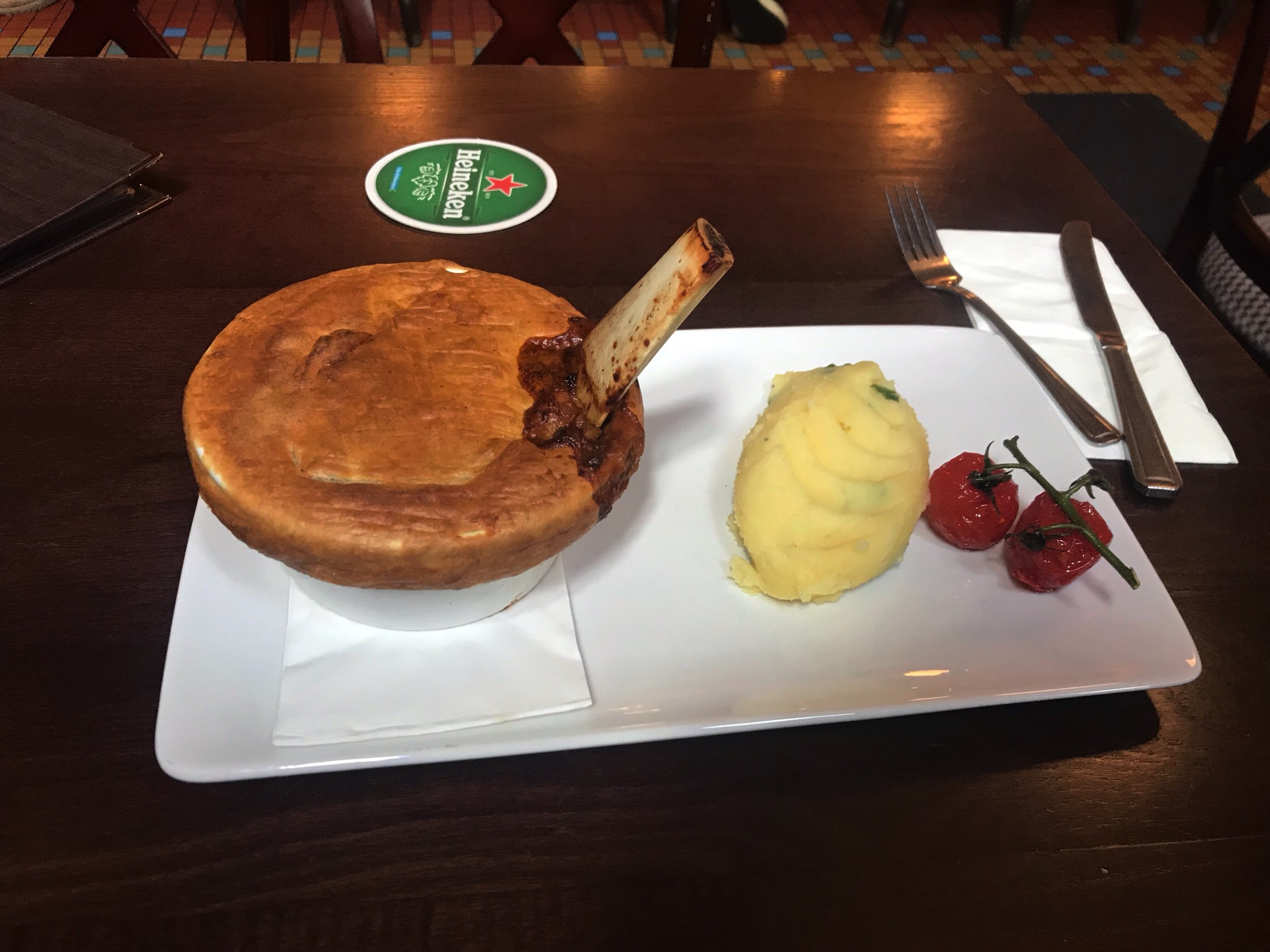
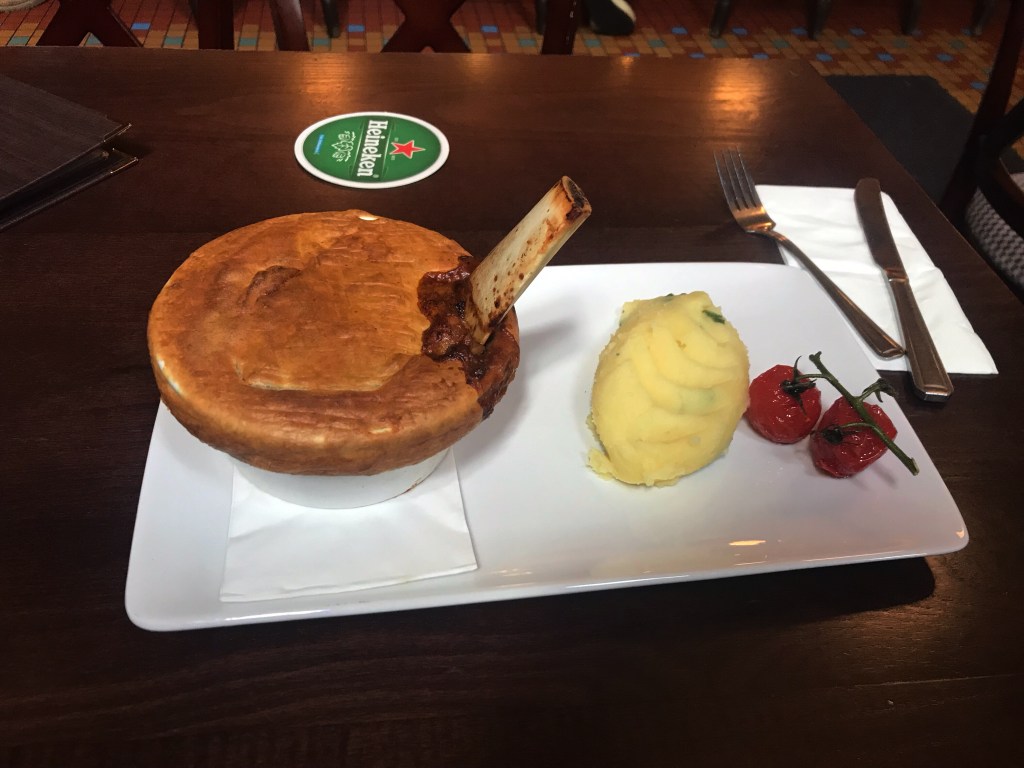
The pies arrived. My beautiful beef and Guinness pie with some mash potatoes on the side. I took one bite, and it was… okay? I guess. The texture was satisfactory, I guess, but the filling was a underflavored and unfulfilling. I was even a bit disappointed with my own disappointment. Maybe my standards for pies are unrealistic. Despite considering pies to be a very Anglo-Saxon dish, I have yet to taste a pie that blew my mind away in the London or Dublin. Perhaps, the problem isn’t with the pie; it is with me.

A day later, I went to another pub called Brian Boru. It was recommended to me by the server of another pub after I asked where I could find an Irish stew. But, unfortunately, when I arrived at Brian Boru, I discovered that they did not serve Irish stews either, which brings an interesting question about locality:

The Irish stew is supposedly a traditional Irish food. But, what is the point of calling it a national dish if so few people in Ireland actually eat it?

Of course, I wouldn’t know if the residents of Dublin actually ate Irish stew because I didn’t take a randomized census. But, from the sheer difficulty I found trying to find a restaurant that served Irish stews, I find it hard to believe that the Irish stew is a part of the regular diet of an average Irish person. I am in pursuit of locality because I have always found food such a beautiful medium to communicate culture, but what is the point of pursuing what I believe to be local when it seems that the locality I envision is actually inauthentic?

It’s fine. I saw on a pie on the menu, so I ordered the pie. Perhaps this moment is how I can redeem the pie that I had had the previous day. Why do I even want pies? Is it because I believe pies to be a very authentically Anglo-Saxon dish? I do like pies, regardless of its origins. I love pies. There are very few things in life that make me happy, but pies make me happy. I want to eat more pies. In this case, they had one pie: a beef and Guinness pie, which was, coincidentally, the exact same pie that I had ordered the previous day.

I waited for about 40 minutes before my pie had arrived. I knew that it would be a good pie precisely because I had to wait 40 minutes for it to arrive. If it had been served, instantaneously, like the £3 pie that I shared with my friend at a cheap fish and chips joint, then I knew it would be a bad pie. It was, proverbially, taking a piss on me. This intuition holds from at very statistically significant rate. Never have I ever had a pie take 40 minutes to make and taste bad, and never had I ever had a pie take 1 minute to make and taste good. It would almost seem as if there existed a correlation between the amount of time put into a pie and the quality of the pie itself.

Low sample size, high variance, but this is my equivalent of statistical truth.

It was not so much a pie as much as a stew with some pie crust on it. The edges of the pie crust were stiff, but I expected as much. I stabbed the pie crust with my fork and watched in satisfaction as the beef and vegetables underneath saturate the pie crust with a medium-thick juice. It was undersalted, in my opinion, but I remedied the dearth in salt by adding salt from the shaker. The beef had been incredibly tender, as it seems that it had been sitting in the pie mix for quite some tie. Sometimes, I would add the mash potatoes on the side into the filling of the pie. That was one of the few good choices that I have made in my life.

The vegetables were chunky and not water-y, thankfully. I like my vegetables chunky. Repeating the cycle of mixing the pie crust and mash potatoes, I finished the pie and licked all the mash potatoes and pie crush from the plate. It was quite satisfying, although it was the first meal I have had after hiking from Dublin City Centre to Glasnevin Cemetary, so maybe I was just really hungry. Or maybe, seeing the grave of Charles Stewart Parnell had instilled in me some form of Irish nationalism that had consecrated into a desire for pies. Who knows?

Whatever. I still miss Philadelphia Chinese food.

afternoon tea @ the fan museum

I did it for the anthropology. It was possibly the bougiest thing that I have ever done. Ever since I had arrived in the UK, I had always wanted to go to an afternoon tea place, but I had never been able to justify to myself such an extravagant outing with such little value. But, seeing as my days in London were numbered, I felt that I would regret it if I never went had afternoon tea before I had left. I searched “cheap afternoon teas” on Google, as if that is not an oxymoron in itself, and I found it. I had the afternoon tea that I had been looking forwards to.

It was £9. In my head, I justified it as: at least, it’s not one of the >£20 varieties. But, even for £9, such a large sum of money spent on tea and pastries was not worth it, even for the anthropology.

I walked past the destination for my afternoon from my trek from the Greenwich Observatory to the Barbican Center. I did not walk past the Prime Meridian because I could not find it. I did not enter the actual observatory either because I felt as if that would just be spending money for the sake of spending money; the University of Greenwich was pretty enough, and the Barbican Center was also pretty enough. These two sights would define the long walk that would suppose to define my final full day in London. I had my camera ready. I hyped up this moment from the previous night. All I wanted was to walk across London have afternoon tea before I can never have afternoon tea, nor will I ever want to, again.

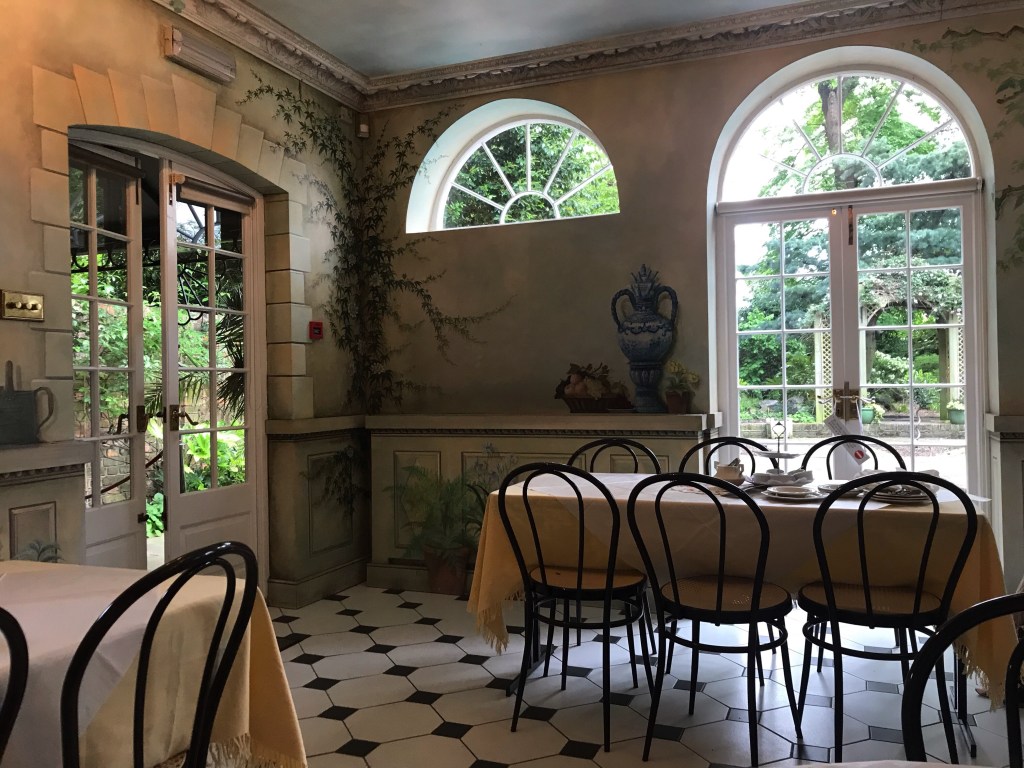
The afternoon tea place was at the fan museum. It is as it sounds; the fan museum is a museum dedicated to the history of fans. I was not interested in the history of fans, so I did not actually enter the museum. The space where the afternoon tea was sold was located in the back of the museum, next to the botanical garden. It was quite an obscure location, and I am surprised that anyone had bothered to mention it at all.

The room had been quite stuffy when I had entered. Despite the room having one window cracked open, the tepid ambiance seemed to almost swelter on its own. The curtains drizzled and melted as if it were that painting by Salvador Dali. There were two tables already occupied, each by two people. On one table, there were two men who sat in silence with each other. One of them was checking their phone; the other was looking out the window. On another table, there were two girls intensely discussing in what I thought to be German. The people were having conversations, but it also seemed as if there weren’t having a conversation. They were just there… before they were having a “conversation”.

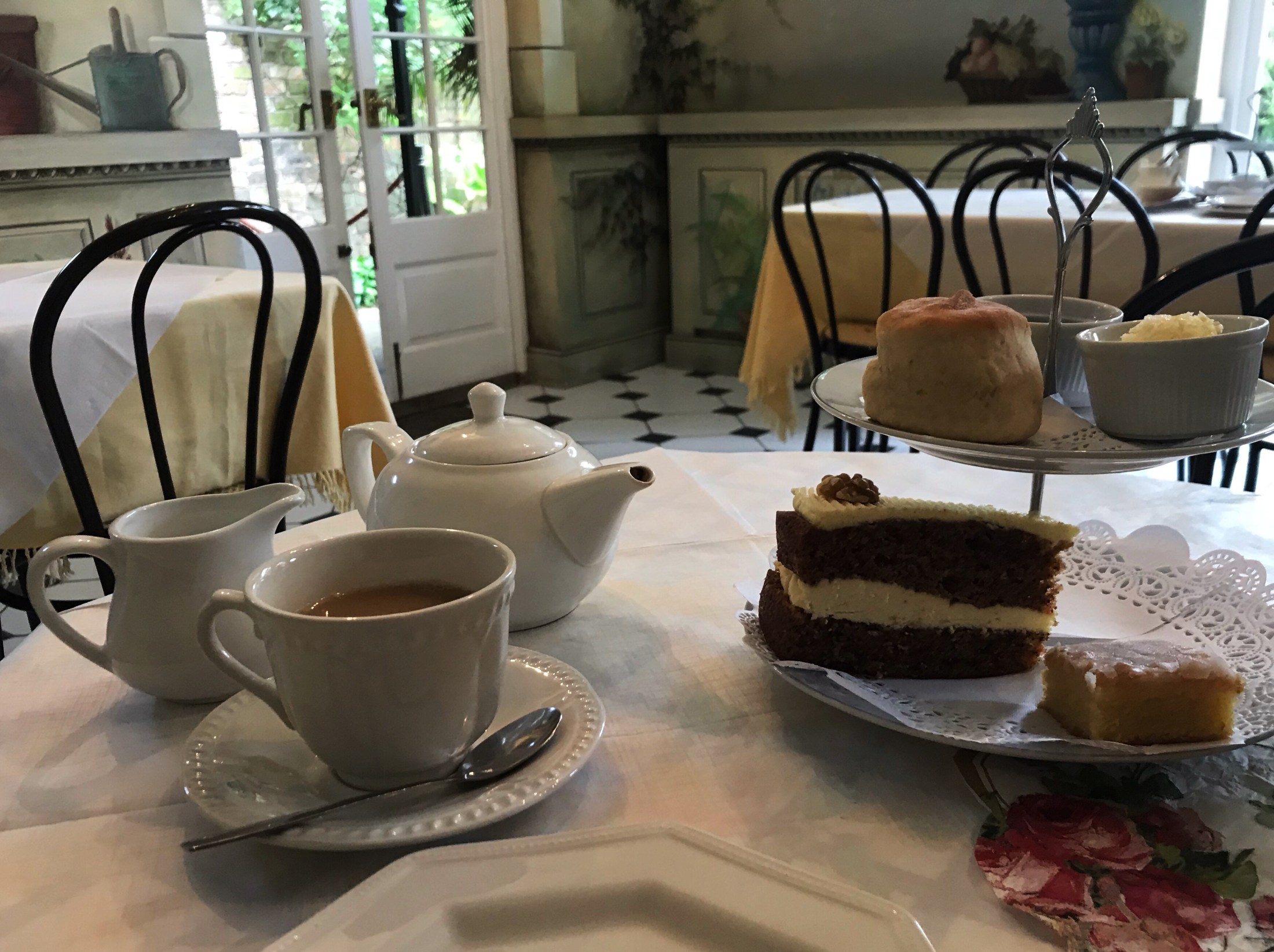
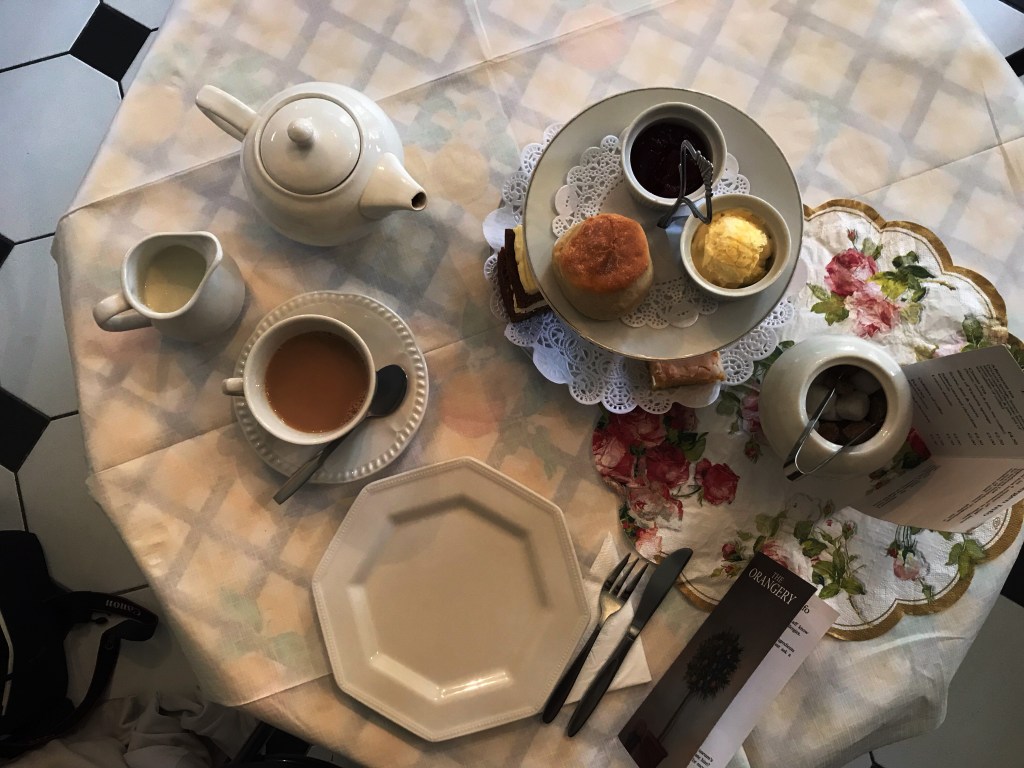
I ordered the afternoon tea, which was the only afternoon tea option from the menu of afternoon tea. It came with Earl Grey tea, a lemon drizzle, a scone with jam and butter, and a Victorian sponge cake that tasted more like a carrot cake. In theory, I expected that it would be this many carbs, but it never actually dawned to me until then that I would be actually eating this many carbs in such a short sitting. I could almost feel the bloatedness from my future self. Similar to string theory, it felt as if the future and present were simultaneously affecting each other. Before, the thought of afternoon tea had been such an abstract, mainly with an emphasis on the tea itself. But, it would seem that this is the difference in actuality.

I delicately drank the tea with milk. The scone with jam was… alright, I suppose. It was a literal scone with jam, and I did not expect much. The lemon drizzle had been a little disappointing because the texture of the bread was incredibly dense, which did not pair well with the gelatinous lemon filling. The Victorian sponge cake was probably the most disappointing of the pastries, however. The cream had completely overpowered the more bread-y regions of the cake, and I had to force myself to finish it.

Most foods follow standard utility curves. The marginal utility is positive, but the second order condition is negative. In this case, the marginal utility was not even positive. With every bite, I hated myself more and more for forcing myself to finish the food. I would not be able to justify to myself of spending £9 on some tea and pastries otherwise. By the time I finished, all I wanted to do was to leave and feel the breeze on my face once again. Greenwich market was my next stop.Anything but the Victorian sponge cake. Anything but the Victorian sponge cake. Anything but the Victorian sponge cake.

Anything but the Victorian sponge cake.